Get Full Government Meeting Transcripts, Videos, & Alerts Forever!
Get email alerts on the State Budget topic
No spam. Unsubscribe anytime.
Utah Senate fast-tracks base budgets, approves multiple House bills on third reading
Summary
On day 10 of the 2019 Utah legislative session the Senate suspended rules to move five House base-budget bills forward and approved them by roll call; it also advanced and read several additional House bills for third reading, recording roll-call tallies for each.
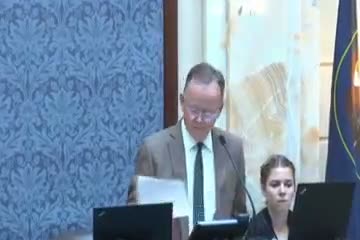
SALT LAKE CITY — The Utah Senate on day 10 of the 2019 legislative session moved quickly through a package of base-budget bills and a set of additional House measures, using suspension motions to expedite second- and third-reading action before adjourning for the day.
President Adams opened the session, acknowledged difficult travel conditions, and the chamber began by receiving communications from the House transmitting the base appropriations bills. Senators voted to suspend the rules and the Utah Constitution’s three‑reading requirement for the base budgets so the measures could be considered immediately.
Senator Matt Grover presented House Bill 1, the higher education base budget, saying, "This is to fund our higher education institutions and our tech that includes all our universities and our technical colleges." He described the total appropriation as $1,900,000,000, including about $330,000,000 from the general fund and additions from the education fund and dedicated credits. Under suspension of the rules the Senate passed HB 1 by roll call: 28 yea, 0 nay, 1 absent. President Adams announced the bill will be signed in open session and returned to the House for the speaker’s signature.
Senator Sandahl presented House Bill 4 (Business, Economic Development and Labor base budget), listing items such as $3,000,000 ongoing for the tourism market performance fund and various transfers and appropriations across agencies. HB 4 passed on final action (reported tally: 27 yea, 0 nay, 2 absent).
Senator Harper described House Bill 5, which included funding for telehealth and adjustments to the firefighters’ retirement trust. HB 5 passed 28–0 with one absence. Senator Cullimore presented House Bill 6 (Infrastructure and General Government base budget), summarizing capital appropriations, internal service fund authorizations and deposits into budget reserve accounts; HB 6 passed 27–0 with two absent. House Bill 7 (National Guard, Veterans Affairs and Legislature base budget) was presented with total operating and capital figures and a note that roughly two‑thirds of the bill’s appropriations go to the National Guard and over 80% of the Guard’s appropriation are federal funds; HB 7 passed 28–0 with one absence.
Beyond the base budgets, the Senate read and advanced several House bills on third reading. Among them: HB 12 (in‑stream flow water‑rights pilot—removal of the sunset to make the voluntary leasing program permanent), HB 19 (pretrial release amendments clarifying expiration or dismissal of certain jail release orders), HB 20 (human‑trafficking amendments to include certain persons with diminished capacity), HB 26 (political‑subdivision/lienholder language), HB 38 (administrative appeal rights), HB 44 (physical therapist practice exam timing), and HB 54 (adoption of updated fire‑code editions with amendments). Roll‑call tallies and procedural motions for these bills were recorded on the floor; where final passage was reported the clerk announced the yea/nay totals and any absentees.
The session included brief recognitions (Senator Hilliard acknowledged students from Ridgeline High School in the gallery) and several procedural announcements (including a noon deadline for appropriation wish‑list submissions). Senator Vickers moved to adjourn; the Senate recessed until 11 a.m. the next day.
Votes at a glance
- House Bill 1 (Higher Education base budget): Passed — 28 yea, 0 nay, 1 absent. - House Bill 4 (Business, Economic Development & Labor base budget): Passed — 27 yea, 0 nay, 2 absent. - House Bill 5 (Retirement & Independent Entities base budget): Passed — 28 yea, 0 nay, 1 absent. - House Bill 6 (Infrastructure & General Government base budget): Passed — 27 yea, 0 nay, 2 absent. - House Bill 7 (National Guard, Veterans Affairs & Legislature base budget): Passed — 28 yea, 0 nay, 1 absent. - Selected additional House bills (HB12, HB19, HB20, HB26, HB38, HB44, HB54, HB56): Advanced or read for third time; roll‑call tallies recorded on the floor; see official minutes for individual outcomes and clerk’s certification.
What’s next
Bills that passed on final action were to be signed by the president in open session and returned to the House for the speaker’s signature. The Senate adjourned until 11 a.m. the following day to continue the session.