Get Full Government Meeting Transcripts, Videos, & Alerts Forever!
Get email alerts on the Water Banking topic
No spam. Unsubscribe anytime.
Senate unanimously backs study of water banking to explore voluntary transfers and pilots
Summary
The Utah Senate unanimously approved a resolution to study water banking, driven by a two-year stakeholder process; the study will examine voluntary, temporary transfers and pilot programs intended to minimize agricultural buy-and-dry while protecting existing water rights.
The Utah Senate on Tuesday unanimously passed Senate Joint Resolution 1, establishing a study of water banking to consider voluntary, temporary transfers of water rights and pilot programs in priority basins.
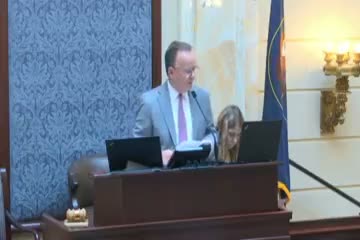
Senator Iwamoto, who sponsored the resolution, told senators the study grew from an in-stream flow effort in 2017 and has developed into a 55-member stakeholder group that has met routinely over the last two years. "It will be locally driven with appropriate state oversight," he said, adding the study aims to “focus on minimizing the need to convert agriculture water rights to supply growing municipal and industrial needs.”
Iwamoto highlighted the study’s scope: examining water-banking concepts such as in-stream flows, split season transfers, and low-transaction-cost mechanisms. He said the group has narrowed options by reviewing Western states with similar conditions and plans pilot projects in the Provo River and Cache Valley that would be self-funding once established. "It is voluntary and temporary transfers while not impairing existing water rights, low transaction costs, and once established will be self funding," Iwamoto said.
Senate leadership noted the resolution aligns with the governor’s State Water Strategy and with bills currently being drafted for the next legislative session. Senator Iwamoto moved the resolution to third reading and final passage; President Adams directed that a unanimous vote be recorded. The clerk announced SJR 1 passed with 24 ayes, 0 nays and five absent and the resolution was sent to the House for further consideration.
The resolution itself establishes a study and does not change water law. Next steps are the stakeholder study work and the pilot projects described by Iwamoto; any policy or statutory changes would require future legislation and separate votes.