Get Full Government Meeting Transcripts, Videos, & Alerts Forever!
Get email alerts on the Appointments And Confirmations topic
No spam. Unsubscribe anytime.
Utah Senate confirms governor’s slate of appointments, including Reuben Renstrom to Second District Court
Summary
In an extraordinary May 2019 session, the Utah Senate consented to a broad slate of gubernatorial appointments. The body unanimously confirmed Reuben Renstrom to the Second District Court and approved multiple board and commission nominations after separate votes on two nominees prompted process objections.
SALT LAKE CITY — The Utah Senate on an extraordinary session in May 2019 consented to a broad slate of appointments submitted by Gov. Gary R. Herbert, including the confirmation of Reuben Renstrom as a judge of the Second District Court.
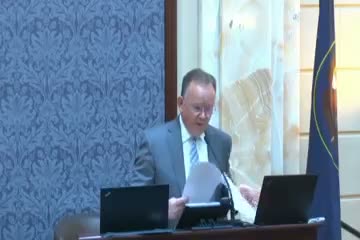
Sen. Todd Wyler, chair of the Senate Judicial Confirmation Committee, told the chamber the committee had voted unanimously to recommend Reuben Renstrom, noting his years of service in justice courts across the Second District. "We had a good confirmation committee meeting with him and we voted unanimously to recommend him to this body to be a district court judge," Wyler said. The Senate then approved Renstrom’s appointment by roll call, the clerk announcing 27 yeas, 0 nays and 2 absent.
Judge Renstrom, who has served as a justice court judge and as chair of the board of justice court judges, thanked the governor and the Senate for the confirmation and introduced family members in the gallery. "This is our democracy and our constitution in action," he said.
After the judge’s confirmation, the clerk read a lengthy list of gubernatorial nominations to state boards and commissions — including positions on the Utah Housing Corporation board of trustees, the Air Quality Board, the Water Quality Board, the Securities Commission and the Department of Natural Resources. The clerk’s readout cited statutory authorities accompanying the nominations.
Sen. Hilliard moved to consent to the full list. Sen. Andreeg said he would support most of the nominees but announced he would vote no on two: Erin Mendenhall’s reappointment to the Air Quality Board and the nomination of Brian C. Steed as executive director of the Department of Natural Resources. Andreeg framed his opposition as a process concern rather than a reflection on the individuals: "My opposition on the vote for, mister Steed has absolutely nothing to do with mister Steed himself, but rather which the governor's office sent that to us. I think that we need to follow a process," he said.
The Senate divided the motion and first voted on the main list (with the two nominees held out). That vote carried in favor (reported in the transcript as 28 yeas, 0 nays, 1 absent). The body then took a separate roll-call on Brian C. Steed and Erin Mendenhall; the clerk reported that vote as 24 yeas, 4 nays, 1 absent, and the Senate consented to those two appointments.
Senate leaders also noted a procedural waiver for the Brian Steed nomination: the president, the majority leader and the minority leader waived the 15-day appointment receipt requirement so the Senate could consider that nomination during the extraordinary session.
The extraordinary session lasted under an hour; with no further business, the Senate adjourned on a motion from Sen. Vickers.
Votes at a glance - Reuben Renstrom — Consent to appointment as judge, Second District Court. Result: 27–0 (2 absent). - Governor’s list (multiple board/commission nominations, excluding Steed and Mendenhall) — Result: vote in favor (transcript reports 28–0, 1 absent). - Brian C. Steed and Erin Mendenhall — Separate roll-call; Result: 24–4 (1 absent).
What it means The extraordinary session was convened under the governor’s proclamation citing Article 7, Section 6 of the Utah Constitution so the Senate could act on appointments made since the 2019 general session. The confirmations place the named individuals onto state boards, commissions and an appellate bench role; several nominees were reappointments to existing panels.
Sources and authorities The governor’s communications read into the record cite the Utah Constitution (Article 7, Section 6; Article 8, Section 8) and Utah Code sections referenced in the governor’s letters (including Utah Code section 78-10-101 and Utah Code 67-1-1 and related provisions). The Senate also recorded committee recommendations and the roll-call tallies in the chamber record.
Next steps Confirmed judicial nominees begin their official duties according to statutory timelines and administrative onboarding for their respective offices. Several of the board and commission appointees will take part in agency governance and rulemaking subject to those entities’ schedules.