Get Full Government Meeting Transcripts, Videos, & Alerts Forever!
Get email alerts on the Criminal Justice Bigamy topic
No spam. Unsubscribe anytime.
Senate advances bigamy reform to reclassify some cases, sponsor says it will help victims report abuse
Summary
First substitute Senate Bill 102 would reclassify bigamy from a felony to an infraction for otherwise law‑abiding polygamous relationships while retaining felony penalties for fraud, coercion or associated serious crimes; sponsor argued decriminalization reduces secrecy and barriers to reporting abuse.
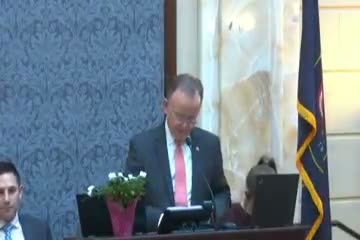
Senator Henderson presented First Substitute Senate Bill 102 on the Senate floor and said the bill rethinks Utah’s long‑standing bigamy statute.
Henderson outlined the history of bigamy enforcement in Utah and described decades of raids and prosecutions that pushed polygamous families into isolation. "After 85 years, I propose it's time to do that with our bigamy statute," Henderson said, arguing that decriminalization for otherwise law‑abiding polygamists would reduce secrecy, encourage reporting of abuse and improve access to services while preserving felony penalties when bigamy is tied to fraud, coercion, child abuse or other serious crimes.
The sponsor said the bill does four things: reclassifies ordinary bigamy as an infraction; treats bigamy obtained under false pretenses as a third‑degree felony; makes threatening or coercing someone into a bigamous relationship a third‑degree felony; and elevates penalties to second‑degree felonies when bigamy is accompanied by specified violent or sexual crimes. Henderson noted support from the statewide association of prosecutors, the YWCA, the ACLU, the Utah Domestic Violence Coalition and others.
She said the change codifies the Attorney General's long‑standing policy of prosecuting only when other crimes are present and provides statutory certainty that prosecutors' non‑prosecution policies will not change abruptly.
The Senate voted to read the substitute a third time; the president recorded 27 yay votes, 0 nays and 2 absent. The bill now proceeds to later stages of the legislative process.