Get Full Government Meeting Transcripts, Videos, & Alerts Forever!
Get email alerts on the Special Session Covid Response topic
No spam. Unsubscribe anytime.
Utah Senate adopts a package of COVID-19–era measures, clears election and tax changes
Summary
The Utah Senate, meeting in a blended special session on Aug. 20, 2020, passed a slate of bills addressing COVID-19 impacts: changes to reporting deadlines, tax-increment extensions for redevelopment, a regulatory pause for certain industries, exemption of some federal COVID relief from state income tax, health-department appointment rules, election-process changes, and law-enforcement tuition reimbursement.
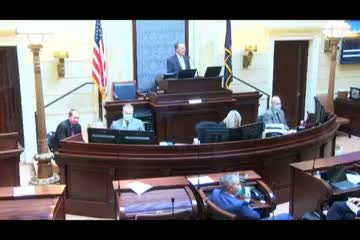
SALT LAKE CITY — The Utah Senate convened in its sixth special session on Aug. 20 and, working under suspended rules for an electronic meeting, passed a package of measures aimed at responding to disruptions caused by the COVID-19 pandemic.
The session opened with a joint proclamation listing topics for consideration, and senators moved quickly to adopt procedural rules allowing bills to be considered electronically and to suspend the constitutional three-reading requirement for the session so measures could be passed immediately.
Several bills that the Senate passed and sent to the House addressed pandemic-related administrative and policy issues. Senator Michael Bramble, sponsor of Senate Bill 6002, said the measure merely moves the consolidated annual financial report due date from Dec. 1 to Dec. 31 to align statutory timing with agency practice. "That's all it does," Bramble said on the floor.
Senator Mike Harper carried multiple bills. A first substitute for Senate Bill 6001 narrows changes to community reinvestment agency law so the measure focuses on an optional, up-to-two-year extension of tax-increment collection for redevelopment project areas that can show they were negatively impacted by the pandemic; Harper said the bill "does not take away any money" from taxing entities and preserves existing budget and cap rules. Senators questioned whether the change would reduce funding for schools; Harper and others responded that existing interlocal agreements and taxing-entity plans remain in place.
Senate Bill 6003, carried by Senator Mike Maine, restores and clarifies a 2017 law enforcement tuition-reimbursement program. Maine described the bill as a fulfillment of a prior promise to officers and said the program reimburses qualifying educational coursework to help retention. The Senate passed that bill unanimously; the clerk recorded 29 yeas and 0 nays.
Senate Bill 6004, carried by Senator Ryan Winterton, holds certain rulemaking in pause for a limited time to provide regulatory certainty to rural industries (including agriculture, oil, gas and mining) and to give agencies time to stabilize during the pandemic. Winterton said the bill "does not change or diminish any of the existing rules or requirements" and that exemptions were included for federally delegated rulemaking or for specific ongoing agency negotiations. The first substitute passed on the floor after debate.
In tax policy, a first substitute for Senate Bill 6005 clarifies that federal loan forgiveness and individual recovery rebates authorized by the federal government in response to COVID-19 will not be treated as Utah taxable income; Harper said the bill aligns state law with federal treatment and prevents taxpayers from "double-dipping" on certain relief. The Senate announced the substitute passed with 28 yeas, 0 nays and 1 absent.
Senate Bill 6006, a Department of Health modification carried by Senator Curt Christensen, changes the statutory experience requirements for an executive director who is not a physician and requires that if the director is not a physician a deputy director be a physician. Christensen said the changes were made, in part, to accommodate a governor’s nominee and to ensure a licensed physician would be in a senior role. Senators debated potential long-term effects of lowering experience-year thresholds and the balance between managerial and medical qualifications before the measure passed.
The chamber also passed a first substitute to Senate Bill 6007, an elections-focused measure that requires counties to offer in-person voting options while allowing greater flexibility (including outdoor, drive-up or drop-box voting) and clarifies provisions related to ballot collection and prohibited practices commonly described as "ballot harvesting." Senator Harper stated that the substitute does not grant emergency authority to the lieutenant governor to prohibit in-person voting; as he put it on the floor, "this does not give the lieutenant governor any emergency powers to suspend in person voting." Senator Iwamoto proposed — and the Senate rejected — an amendment to move county mailing earlier for the November election (from 21 to 28 days), arguing the extra week would help rural voters and relieve workload on clerks.
What the Senate approved
Votes at a glance (Senate action; sent to House where noted): - SB 6002 (Financial report date amendment) — passed under suspension; transmitted to House. - SB 6001 (Community reinvestment agency first substitute) — substituted and passed under suspension; transmitted to House. - SB 6003 (Law enforcement tuition reimbursement) — passed unanimously (29–0); transmitted to House. - SB 6004 (Regulatory certainty first substitute) — passed under suspension (floor reported 25 yeas, 3 nays); transmitted to House. - SB 6005 (Income tax amendments — federal COVID relief) — first substitute passed (28 yeas, 0 nays, 1 absent); transmitted to House. - SB 6006 (Department of Health modifications — first substitute) — passed under suspension; transmitted to House (vote tally not specified verbatim in the floor transcript excerpts provided). - SB 6007 (Elections first substitute) — passed under suspension (floor reported 26 yeas, 0 nays, 3 absent); transmitted to House.
Senators said many of the bills were intended as time-limited pandemic relief or clarifications. Sponsors and several supporters framed the measures as fixes to preserve existing commitments (for example, law-enforcement tuition reimbursement and tax-increment projects) or as temporary pauses to give agencies and industries breathing room while the state responds to COVID-19 economic impacts.
Quotes and exchanges
"That's all it does," said Senator Michael Bramble of SB 6002, summarizing the CAFR date change.
Senator Mike Harper said of exempting federal relief from state income tax: "We're just acknowledging the fact we are not going to impose a tax on this." (floor remarks on SB 6005.)
Senator Ryan Winterton, sponsor of the regulatory pause, said the bill "does not change or diminish any of the existing rules or requirements; it won't degrade air quality or other environmental protections." (floor remarks on SB 6004.)
Senator Curt Christensen said the health-department substitute ensures a physician-level medical role will remain available in the department: "if the executive director is not a physician, then a deputy will be a physician." (floor remarks on SB 6006.)
Process notes and next steps
All measures passed by the Senate were transmitted to the House for consideration. The Senate recessed for caucus and lunch and planned to reconvene at 1:30 p.m. on the same day.
Corrections and limitations
This account relies on the official floor transcript of the Senate session. A small number of transcription artifacts in the floor record (for example misspellings or OCR-like errors) were corrected for clarity in this article; where the transcript did not supply an explicit numeric roll-call tally on the record excerpt, the article either reports the tally given verbatim in the transcript or notes that the count was not specified in the excerpt.