Get Full Government Meeting Transcripts, Videos, & Alerts Forever!
Get email alerts on the School Resource Officers topic
No spam. Unsubscribe anytime.
Senate circles SRO amendment after questions over contract and reporting language
Summary
Senators agreed on the need for memoranda of understanding and student-rights notifications for school resource officers but circled first substitute HB345 to resolve ambiguous contract-approval language and reporting overlaps before final passage.
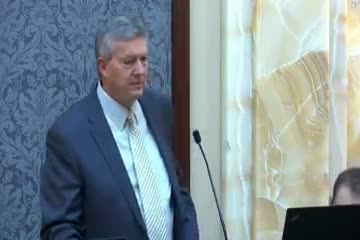
Senators on the Utah Senate floor on the second-reading calendar on HB345, a bill to clarify school resource officer (SRO) roles and training, agreed on several reforms but voted to 'circle' the bill for further work.
Sponsor Senator Thatcher said the bill follows an interim working group and earlier legislation requiring memoranda of understanding (MOUs) between local education agencies (LEAs) and law enforcement, and emphasized protections for students. "It requires that students be given a detailed description of their constitutional rights," Thatcher said, arguing such notices mirror a recent bill that blocks interrogation of students without a parent present.
Senator Fillmore and others pressed the sponsor on multiple provisions they said risk making the bill unworkable for districts. Fillmore pointed specifically to language (line 78 in the bill text) saying an "LEA governing board, including law enforcement, must review and approve a contract," and asked who "law enforcement" refers to and how a governing board would secure approval from an undefined party. Fillmore said the section requires the LEA to collect and report a wide range of information — "none of which has anything to do with actually enforcing laws," he said — and urged stripping the post-line 72 changes or substituting the language.
Thatcher acknowledged uncertainty about the precise drafting choices but said the line was "specifically requested by law enforcement for this purpose" and that MOUs and clearer expectations would reduce mismatched expectations. Senator Riebe and others also noted wide variety among LEAs across the state and asked whether the bill's metrics could be tailored to different districts; Riebe argued the bill offers flexibility for local metrics and said the state-level reporting requirement (cited as section 53e-3-516) remains a distinct baseline.
Several senators, including Senator Espinilla, voiced support for the bill's consensus language emerging from interim work and for the use of performance measurements to track outcomes. After discussion, Senator Thatcher moved to circle the bill so the Criminal and Juvenile Justice Commission (CCJJ) and stakeholders could answer detailed queries — the motion to circle was adopted.
Next steps: HB345 was circled for further drafting and stakeholder consultation; the sponsor signaled willingness to consult the House sponsor and CCJJ before bringing a clarified substitute back to the floor.