Get Full Government Meeting Transcripts, Videos, & Alerts Forever!
Get email alerts on the Budget topic
No spam. Unsubscribe anytime.
Utah Senate fast-tracks budget bills, advancing $2 billion in higher-education and infrastructure funding
Summary
The Senate on Jan. 28 advanced a package of House-transmitted budget bills to passage under suspension, approving first-substitute HB 4 (business and labor), HB 1 (higher education base), 1st substitute HB 6 (infrastructure/general government), HB 7 (National Guard/veterans/legislature) and 1st substitute HB 8 (compensation adjustments).
The Utah Senate voted on Jan. 28 to adopt a group of House-passed budget bills, moving several major appropriations measures to the House for final action.
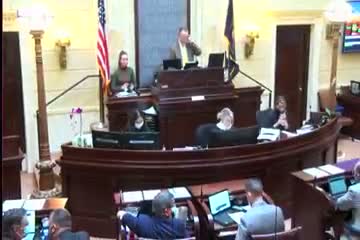
Senators lifted a set of base budget bills to the top of the second-reading calendar and, by unanimous or near-unanimous voice and roll-call votes, approved the measures under suspension of the rules. President Adams announced a quorum before the actions.
First Substitute House Bill 4, the business, economic development and labor-based budget, was substituted and adopted after the sponsor described additions that “adds $15,000,000 for the Learn and Work program in Utah, also known as the COVID-19 Displaced Worker Grant program,” plus $3,000,000 for statewide marketing and $2,500,000 for a small business quarantine grant program to the Department of Labor. The substituted bill passed on a roll-call vote and the president announced it "having received 28 yay votes, 0 nay votes, 1 being absent."
House Bill 1, the higher-education base budget, was described as appropriating about $2,000,000,000 to the state’s eight colleges, eight technical colleges and the State Board of Regents. According to the sponsor, $421,000,000 is from the general fund, $766,000,000 from the education fund and $928,000,000 from dedicated credits (mostly tuition). The chamber passed HB 1 under suspension; the clerk recorded it as having received 28 yay votes and 0 nay votes, with 1 absent.
First Substitute House Bill 6 (infrastructure and general government) includes appropriations for Olympic facilities, rural emergency medical services, airport construction, transportation projects funded with federal stimulus and capital/debt service. The sponsor said the bill appropriates $264,000,000 in the current fiscal year for operating and capital budgets and cited other specific allocations; the Senate passed the bill (clerk: 26 yea, 0 nay, 3 absent recorded in the transcript).
House Bill 7 (National Guard, Veterans Affairs and Legislature) was presented as a roughly $111,000,000 package with $48,000,000 from the general fund, including funding for veterans’ nursing homes and the firefighters retirement trust; the Senate approved the bill.
First Substitute House Bill 8 provides a 3% labor-market increase for state employees and higher-education employees, step increases for Utah Schools for the Deaf and Blind, retirement-rate changes and other salary adjustments. The Senate passed the measure under suspension; the transcript records passage and subsequent transmittal to the House for the Speaker’s signature.
Senators used the floor time to formally recognize legislative staff, including LFA analysts, for the heavy workload of budget preparation this cycle. All budget bills approved on Jan. 28 were read as passed by the Senate and returned to the House for the Speaker’s signature, according to the record.
What happens next: The bills will be enrolled and sent to the House (and ultimately to the governor as required by the legislative process). The Senate adjourned at the close of the floor session.