Get Full Government Meeting Transcripts, Videos, & Alerts Forever!
Get email alerts on the Legislature topic
No spam. Unsubscribe anytime.
Utah Senate opens 2023 session; J. Stuart Adams elected president and dozens of bills introduced
Summary
On Jan. 17, 2023, the Utah State Senate formally organized for the 2023 general session, elected J. Stuart Adams as Senate president by acclamation, adopted interim rules (including suspension of long-title readings), announced leadership, and read the short titles of dozens of bills placed on the second-reading calendar.
The Utah State Senate convened Jan. 17, 2023, at the State Capitol in Salt Lake City and formally organized for the 2023 general session. President Pro Tem Taylor Randall called the chamber to order, leaders swore in newly elected members and the Senate elected J. Stuart Adams as president by acclamation.
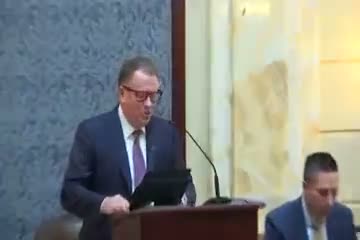
Adams took the podium after the oath and opened the session with a wide-ranging address that focused on water, infrastructure, taxes, education and transportation. "2023 will be the year of the tax cut again, again, and again," Adams said, framing tax relief as a central priority while also praising record education funding and urging further support for teachers. He urged long-term planning for water infrastructure and said, "last year, we allocated almost $500,000,000 to our state waters infrastructure," while calling for continued investment in conservation and supply solutions.
On procedure, Senator David Buxton moved that the Senate adopt the interim joint rules from 2022 until the body adopts new rules for 2023; the motion passed. Buxton also moved to continue the practice of reading only short titles for bills and resolutions unless the Senate votes to read long titles; the Senate approved suspending long-title readings by the constitutionally required two-thirds majority.
Leadership and staff appointments were announced for the journal: Majority Leader Evan Vickers and Minority Leader Luz Escamilla were among the leadership names recorded for the Senate Journal; Adams also named committees to notify the governor and the House that the Senate is organized. Senator Kirk Cullimore moved to have President Adams' remarks printed in the Senate Journal; that motion passed.
Clerks read short titles for a large docket of proposed legislation (bills, concurrent and joint resolutions) covering topics including water infrastructure studies, education funding and policy, transportation and public-safety measures, tax and revenue items, professional licensing, and proposed constitutional amendments regarding revenue and property tax exemptions. The clerk said the bills would be placed on the second-reading calendar in the order read and referred to the Rules Committee for consideration.
Senator Luz Escamilla, the Senate minority leader, thanked retiring colleagues and outlined minority caucus priorities including conservation of the Great Salt Lake, water policy, affordable health care, education access and housing stability. The Senate recessed with a motion to reconvene at 2 p.m. in the House Chamber for the State of the Judiciary address by Chief Justice Matthew Durrant.
Procedural votes on ceremonial matters, adoption of interim rules, suspension of long-title readings, and the motion to recess were taken by voice and passed; roll-call tallies were not recorded in the transcript for those voice votes.
The session also included ceremonial elements — an invocation by Elder Matthew S. Holland, presentation of colors by the Utah Air National Guard, a pledge led by Brig. Gen. Joseph W. Green and a performance by the American Heritage School Orchestra — and the formal introduction of session interns and staff who will support the Senate during the 45-day general session.
The Senate adjourned to reconvene at 2 p.m. in the House Chamber for the State of the Judiciary.