Get Full Government Meeting Transcripts, Videos, & Alerts Forever!
Get email alerts on the Public Safety Retirement topic
No spam. Unsubscribe anytime.
House advances changes to Tier 2 public-safety retirement, citing recruitment and retention needs
Summary
On March 14, 2019, the Utah House voted to advance a third substitute for Senate Bill 129, a measure that delays implementation until July 1, 2020, increases employer contributions for Tier 2 public safety employees and aims to restore a 50% retirement benefit at 25 years. Sponsors said it will help recruit and retain police and firefighters; members debated fiscal impacts to state and local budgets.
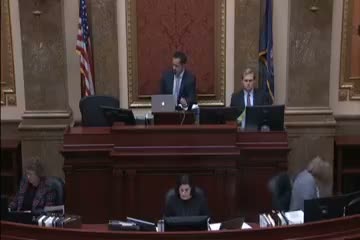
The Utah House of Representatives on March 14 advanced a rewritten version of Senate Bill 129 aimed at restoring more generous retirement benefits for Tier 2 public-safety employees, including police, firefighters and corrections officers.
Representative Perry, the House sponsor, told colleagues that the third substitute delays implementation to July 1, 2020, raises the participating employer contribution in the defined-benefit portion of the plan from 12 percent to 14 percent, and restores a 2 percent multiplier so eligible members will be able to reach a 50 percent retirement benefit after 25 years of service. “We’re gonna get them to 50%,” Perry said during floor remarks, adding the change is intended to improve recruitment and retention.
Supporters said the changes respond to staffing difficulties in law enforcement and corrections. Representative Hutchings said the state’s correctional system is carrying large numbers of vacant positions and that market studies show pay and benefits materially affect recruitment. Representative Stoddard said the package corrects an inequity for Tier 2 public safety employees who must serve long, hazardous careers for a smaller retirement payout.
Opponents and questioners pressed the sponsor for fiscal detail and for clarity on which governments will carry costs. Representative Winder and others asked how much the state will cover and how much will fall to counties and cities. Perry responded that the bill’s phased approach means costs rise over time as more Tier 2 employees are hired. He cited an earlier fiscal estimate of roughly $5.3 million for the initial plan year that would increase to about $6.6 million, with the state’s portion roughly $2.2 million in the first year after the delayed implementation.
Several members urged caution about the ongoing local cost: Representative Brammer asked whether counties and cities would be required to absorb roughly $4 million of the first-year increase; Perry confirmed that local employers would share the remaining obligation and that costs would be distributed across jurisdictions depending on agency size.
After extended questioning and floor discussion, the House substituted in the third substitute and adopted the measure on a recorded vote. Third Substitute Senate Bill 129 passed the House with 65 yes votes and 2 no votes and will be returned to the Senate for further consideration.
The bill also includes study provisions to assess the multiplier and implementation; sponsors said they will work with the Association of Counties, municipal leaders and retirement oversight committees during the interim to monitor effects and fiscal exposure.