Get Full Government Meeting Transcripts, Videos, & Alerts Forever!
Get email alerts on the C‑pace Energy Finance topic
No spam. Unsubscribe anytime.
Senate expands C‑PACE eligibility to aid large renewable and biotech projects
Summary
The Senate passed House Bill 116 to clarify Commercial Property Assessed Clean Energy (C‑PACE) financing so exported biofuels will not disqualify projects; sponsor said the change will help projects such as a cited $300 million biotech development.
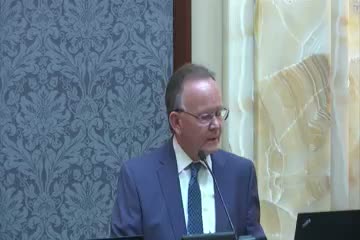
Sen. David P. Hinkins presented House Bill 116 on Feb. 2, 2024, proposing changes to the Commercial Property Assessed Clean Energy (C‑PACE) program that would allow developers to retain C‑PACE financing even when biofuels produced on site are exported for sale.
"To qualify for C PACE funding under the current law, biofuels can only be used on a site of development and C PACE funding cannot be retained if the biofuels are exported for sale," Sen. Hinkins said in explaining the bill’s intent. He added the bill corrects language that had been written with sale of electricity in mind and was not well suited to other renewable energy sources. The sponsor cited Wellington’s MicroTech, a roughly $300 million biotech production facility, as an example of projects that could benefit from expanded financing options.
Sen. Hinkins told the body that private banks provide C‑PACE capital and that the financing does not draw on state or federal funds. He said the amendment will allow biofuel producers to access private capital for large renewable projects without jeopardizing the financing if product is sold off‑site.
Sen. Harper, speaking in support, noted the measure implements recommendations from the Office of the Legislative Auditor General to improve transparency and reporting for participating redevelopment agencies and to clarify what happens to unexpended project area funds after five years.
With little additional debate, the Senate put the bill to a roll‑call vote. House Bill 116 passed the Senate 27‑0 with two members absent and was returned to the House for further consideration.
The bill changes the statutory language governing C‑PACE participation agreements and is intended to broaden access to private clean‑energy financing for certain large commercial projects. The exact budgetary impact on state or local budgets was not specified on the floor; sponsors described the change as enabling access to private capital rather than creating a state funding obligation.