Get Full Government Meeting Transcripts, Videos, & Alerts Forever!
Get email alerts on the State Legislation topic
No spam. Unsubscribe anytime.
Utah House passes a string of Senate bills, circles several for later review
Summary
On March 6, 2019, the Utah House approved multiple Senate measures on the third-reading calendar — including bills on corporate conduct, real estate licensing, pharmacy regulation, school vision screening, community reinvestment reporting and corrections officer certification — and circled several others for further work.
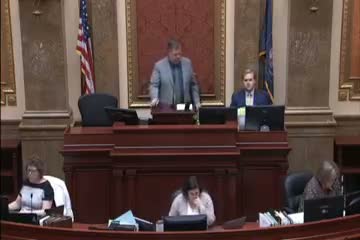
The Utah House of Representatives on March 6, 2019, passed a series of Senate bills on the third-reading calendar and set aside others for later consideration.
Representative Waldrop, the floor sponsor for Senate Bill 133, told the chamber the measure codifies a state Supreme Court decision to provide remedies for shareholders in closely held corporations who face coercive or unfair conduct. "This codification matches how other states have dealt with it as well to provide for the courts to seek remedy for those affected shareholders," Waldrop said. The House approved S.B.133, 65-1.
The chamber also approved S.B.140 (real estate amendments), which Representative Musselman said creates a 120-day transitional license for mortgage loan officers coming from other states, requires fingerprinting for appraisers upon initial licensure and renewal, prohibits sales agents from removing brokerage files when they leave a firm, and gives the division new citation authority; the bill passed unanimously, 70-0.
Other bills the House passed included S.B.143 (moving oversight of school vision screening from the Department of Education to the Department of Health), S.B.170 (pharmacy and pharmaceuticals amendments clarifying telepharmacy, technician duties and limited in-office dispensing), S.B.56 (requiring a CRA report database hosted by GOED, with GOED estimating $80,000 ongoing and $40,001 one-time costs), and S.B.125 (closing a privacy gap in vehicle registration records). Vote tallies were announced on the floor as each measure passed.
On criminal justice policy, Representative James A. Dunnigan explained S.B.162 lowers the minimum age for county correctional officer certification from 21 to 19 as an optional tool counties can use to recruit more guards and provide training and retirement benefits to younger recruits. "This legislation changes it to 19," Dunnigan said; the House approved the bill, 68-0.
A debated measure that drew member questions was S.B.114 (hunting amendments). Representative Carl Albrecht said the bill allows a rancher to use aerial hunting on private property or grazing allotments under an annual permit from the Department of Agriculture for control of unregulated predators. Members asked about who would issue permits and whether protected species could be targeted; the sponsor and other members clarified that permits would come from the Department of Agriculture and the bill excludes protected species. The House passed S.B.114, 65-3.
Several bills were "circled" (set aside) for further work, including S.B.166 (teacher and student success act), S.B.72 (transportation governance and funding revisions) and S.B.131 (ignition interlock amendments). Representatives stated they wanted time to resolve questions or await substitutes before final consideration.
The House recessed for 15 minutes at the end of the floor session and planned to return at 3:30 p.m.
Votes at a glance (selected floor outcomes announced March 6, 2019): S.B.133 — passed 65-1; S.B.140 — passed 70-0; S.B.143 — passed 67-0; S.B.170 (first substitute) — passed 68-0; S.B.56 (first substitute) — passed 68-0; S.B.162 — passed 68-0; S.B.114 — passed 65-3; S.B.125 — passed 67-0. Several other measures were circled for later consideration. The House indicated bills returned to Rules when fiscal notes or substitutions were pending.