Get Full Government Meeting Transcripts, Videos, & Alerts Forever!
Get email alerts on the Floor Session Votes topic
No spam. Unsubscribe anytime.
Utah House advances package of public-safety, agriculture and transportation bills after full-floor debate
Summary
On March 5, 2019, the Utah House adopted a series of bills and one concurrent resolution after floor debate, including hit-and-run amendments, rules for on-farm slaughter of domesticated game, single rear license plate implementation, towing-rotation reforms, CDL employer notification requirements, amusement-ride safety standards, and a peer-to-peer car-sharing tax parity measure.
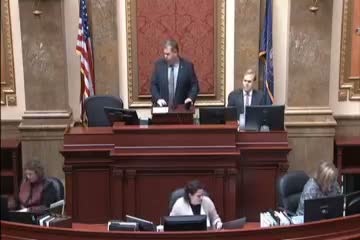
The Utah House on March 5 moved through a slate of bills affecting public safety, agriculture, transportation and consumer services, adopting several substitutes and sending them to the Senate after floor debate and votes.
Lawmakers opened with a concurrence and final-passage vote on House Concurrent Resolution 6, designating May 5 as Missing and Murdered Indigenous Women, Girls and LGBT Awareness Day, which passed 58-9 and will return to the Senate for signature. Over subsequent hours the House debated and approved measures on hit-and-run penalties, domesticated-game slaughter, single-plate license rules, towing regulation, CDL employer reporting, amusement ride oversight and peer-to-peer car sharing.
Supporters described the results as targeted fixes and updates. "Last year we moved some hit-and-run charges down from a class B misdemeanor to a class C misdemeanor... You may find it surprising that there are 4,000 hit-and-runs in Utah every year," Representative Eliason said while urging passage of the hit-and-run amendments, which the House approved 67-1. The measure restores certain property-damage hit-and-run offenses to a class B misdemeanor, the sponsor said, to address enforcement gaps when cases were pled down to infractions.
Agriculture-focused lawmakers approved third-substitute House Bill 412, creating a statutory pathway for on-site slaughter of certain domesticated game (for example elk and bison) and defining amenable and non-amenable species to align state authority with USDA/FDA requirements. "This bill creates a process to allow individuals who are raising domesticated elk, bison... to slaughter these animals at the farm on-site," Representative Roberts said; the measure passed 69-0.
On vehicle-registration policy, the House adopted an amendment and then passed second-substitute House Bill 207, which removes the general requirement for two license plates and phases the state toward display of one rear plate for most passenger vehicles while carving out commercial intrastate vehicles. Sponsor Representative Watkins said the change aligns Utah with other states and that the DMV would transition plates as existing stock is exhausted. Representative Perry, speaking in opposition, cautioned that front plates aid law enforcement in identification and amber-alert situations, saying, "If you have just one plate on the car, you're making it twice as hard for law enforcement." The bill passed 41-28.
Transportation and small-business provisions included third-substitute House Bill 228, which adjusts towing-rotation rules, requires due process for cities that remove tow companies from rotation, and clarifies insurance and dispatch requirements; Representative Malloy said the changes protect small tow operators while giving cities tools to keep unsafe providers off rotations. The House approved the substitute 67-3.
The chamber also approved House Bill 279, requiring employers of commercial drivers to subscribe to a notification service that provides near-real-time reports of moving violations or DUIs for CDL drivers, a provision supporters described as a low-cost way to reduce risk on highways. Representative Quinn described existing services costing about $1.44 per employee per year and private alternatives averaging roughly $7 annually; the bill passed 38-27.
Safety for amusement rides drew extended debate in a lengthy floor discussion of House Bill 381. Sponsor Representative Potter argued Utah is one of six states without statewide amusement-ride inspection and proposed a light regulatory framework: a six-member advisory committee, certification of third-party inspectors, required liability insurance for operators, and a director position funded by permit fees. Potter said the bill would rely on ASTM F24 inspection standards and place the primary inspection burden on certified third-party inspectors rather than the state. Members pressed how the law would affect small-town festivals, liability and the bill's fiscal note; Potter said the measure is designed to be procedural and industry-funded. The first substitute passed 65-6.
On technology and taxation, the House passed a narrowed second substitute to House Bill 354 that focuses on peer-to-peer car sharing and tax parity for hosts. Representative Coleman said the substitute removes airport and broad local regulatory provisions and seeks to create parity with traditional rental fleets on certain taxes while leaving other matters—such as marketplace-facilitation rules and airport concession negotiations—to existing frameworks and local authorities. The substitute passed 50-22.
Votes at a glance
- H.C.R. 6 (designating May 5 awareness day): passed 58-9 (concurred with Senate amendments). (SEG 507–509). - First substitute, H.B. 313 (hit-and-run amendments): passed 67-1 (final passage). (SEG 577–579). - Third substitute, H.B. 412 (domesticated game slaughter): passed 69-0 (final passage). (SEG 789–791). - Second substitute, H.B. 207 (license-plate placement): passed 41-28 (final passage). (SEG 1089–1090). - Third substitute, H.B. 228 (towing revisions): passed 67-3 (final passage). (SEG 1216–1217). - H.B. 279 (traffic-violation employer reporting): passed 38-27 (final passage). (SEG 1373–1376). - First substitute, H.B. 381 (amusement-ride safety): passed 65-6 (final passage). (SEG 1916–1917). - Second substitute, H.B. 354 (peer-to-peer car sharing): passed 50-22 (final passage). (SEG 2530–2532).
What happens next
Several of the bills were sent to the Senate for further consideration, and committees received additional assignments and rules reports. The House recessed until 3 p.m.
Quotes and source notes in this report are drawn verbatim from recorded floor remarks during the March 5, 2019 House session; vote tallies are as announced on the floor.