Get Full Government Meeting Transcripts, Videos, & Alerts Forever!
Get email alerts on the Firearm Suicide Prevention topic
No spam. Unsubscribe anytime.
House approves revised firearm suicide‑prevention bill with lock distribution and education provisions
Summary
Representative Elison’s floor amendment to HB 17 reinstates an education and lock‑distribution program, adds requirements for a brochure, supplies trigger locks with long‑gun purchases, and establishes a brief video at concealed‑carry renewal; the House passed the bill 66–4 and sent it to the Senate.
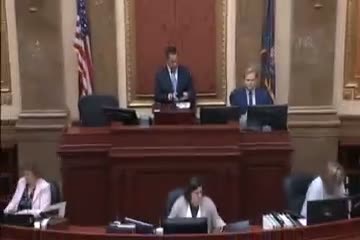
The Utah House on Feb. 26 approved first substitute House Bill 17, a package of firearm violence and suicide‑prevention amendments that restores an education program and adds provisions for lock distribution and concealed‑carry renewal education.
Representative Elison, the bill sponsor, told the House the legislation is intended to "reduce the number of suicides in Utah," describing the measure as a continuation of a previously successful program that provided brochures and trigger locks. Elison cited statistics from a study commissioned by the Legislature and conducted by the Harvard School of Public Health, saying roughly 85 percent of firearm deaths in Utah are suicides and noting that last year the state recorded about 650 suicides, approximately 40 of them children. Elison said studies show 80 percent of attempts using firearms are fatal and that many youth suicides involve firearms that belong to the victim or a family member.
The bill, as amended on the floor (Amendment #1), requires distribution of a cable‑style trigger lock with the purchase of a long gun at no charge to the buyer or reseller; the locks would be supplied by the state. It also requires that a brief educational video be viewed when an individual renews a concealed‑carry permit; that video would be jointly produced by representatives of the shooting‑sports industry, the Bureau of Criminal Identification and the Division of Substance Abuse and Mental Health. The measure preserves voluntary elements: it does not require firearms owners to use the distributed locks.
Sponsor remarks included demonstrations and examples of safety devices. Elison highlighted a biometric gun safe produced locally in Lehi (identified in floor remarks as "The Gunbox") and described a voluntary coupon program to help offset costs for families affected by suicide. Elison said prior program efforts distributed roughly 50,000 trigger locks and that last year Utah saw a double‑digit decline in youth suicide, while acknowledging that the decrease cannot be definitively attributed to a single program.
During floor questioning, Representative Seigmuller asked about the bill’s fiscal note and how costs would be allocated; Elison said funding will be restored from prior appropriations and supplemented with one‑time money for a biometric safe pilot, drawing on excess funds in the concealed‑carry permit fund and with a small ongoing general‑fund appropriation for brochure production and lock distribution.
After debate and a waived summation, the House adopted the amendment and passed HB 17 by roll call, 66 yeas to 4 nays. The bill was transmitted to the Senate for further consideration.
What’s next: The bill will proceed through the Utah Senate, where it may face additional committee review or amendment.