Get Full Government Meeting Transcripts, Videos, & Alerts Forever!
Get email alerts on the Healthcare Medicaid Expansion topic
No spam. Unsubscribe anytime.
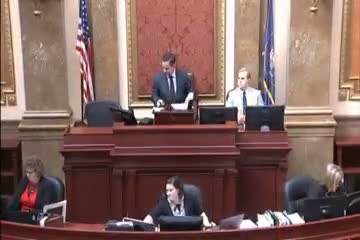
Utah House adopts fourth substitute to SB 96 to expand Medicaid coverage; 56–19
Summary
After hours of debate on fiscal sustainability and waiver conditions, the Utah House passed the fourth substitute to Senate Bill 96 — a Medicaid-expansion package that preserves a waiver-seeking approach while including a House-backed backstop — by a 56–19 vote. The House rejected a broader sixth substitute earlier in the day.
The Utah House of Representatives on Feb. 8 voted 56–19 to pass the fourth substitute to Senate Bill 96, a measure that seeks to expand Medicaid coverage for adults in the state’s coverage gap while directing the Department of Health to pursue federal waivers and building in a legislative backstop if those waivers are not approved.
Representative Dunnigan, the House sponsor, told colleagues the fourth substitute aims to protect the program’s long-term finances by removing a guaranteed cost-of-living increase to provider payment rates that he said accounts for about 30 percent of the measure’s projected cost. “One of the financial challenges with Proposition 3 is that it provides a cost-of-living pay raise to providers,” he said on the House floor. He described the substitute as a way to secure coverage now while continuing to press for a more favorable federal match.
The debate focused on two linked issues: whether the state should seek a waiver that would secure an enhanced federal match (the sponsor said the bill asks the state to seek a 90 percent federal match for a target eligibility threshold) and whether to adopt a broader substitute that more closely tracks Proposition 3’s original coverage levels. Representative Daley-Provost offered a sixth substitute she described as more faithful to Prop 3; after extended floor argument, the House voted to reject that sixth substitute and keep the fourth substitute as the vehicle for expansion.
Supporters, including Representative Winder and Representative Ward, argued the fourth substitute balances the electorate’s mandate with the legislature’s constitutional duty to balance the state budget and delivers coverage starting April 1 for those eligible under the plan. Ward recounted a constituent medical emergency to underscore the immediate health consequences of being uninsured.
Opponents pressed fiscal concerns and cited experiences in other states. Representative Brammer and others warned of high enrollment and cost overruns in states that expanded Medicaid; Representative King and others questioned reliance on novel federal waivers and whether the plan’s temporary elements could expose the state to legal or budgetary risk if federal approval were not forthcoming.
The bill’s sponsor said the fourth substitute includes a bridge plan to begin enrollment on April 1 under a 70/30 federal-state funding assumption if the preferred waiver has not been approved, and retains House Bill 210 as a legislative backstop to avoid a coverage cliff. After the previous-question motion closed debate, the House voted to pass the fourth substitute; the clerk announced passage and directed transmission of the measure to the Senate for further consideration.
What happened next: the bill will be transmitted to the Senate for its consideration. The House also adopted procedural measures earlier in the day to place SB 96 at the top of the calendar for immediate consideration.
Quote examples from floor debate: “We expand to 138 and everybody’s covered up to 138,” Representative Dunnigan said while describing the backstop option. “We’re proposing to provide coverage for everybody else in the coverage gap.”
Representative Paulson, arguing for the broader substitute, said the alternative “is in the spirit of Prop 3” and called the substitute more cost-effective and less complex than the underlying bill.
Next steps: SB 96, in its fourth-substitute form, will go to the state Senate for further action; sponsors and staff indicated enrollment could begin April 1 if federal approvals allow a bridge plan to operate while the state continues to pursue an enhanced-match waiver.