Get Full Government Meeting Transcripts, Videos, & Alerts Forever!
Get email alerts on the Legislative Organization And Early Votes topic
No spam. Unsubscribe anytime.
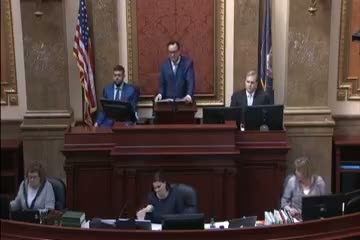
Brad Wilson sworn in as House speaker; Utah House quickly adopts rules and passes multiple measures
Summary
Representative Brad Wilson was elected and sworn in as Speaker of the Utah House. In opening business the House adopted interim rules, authorized in-session employee pay and unanimously passed several bills and resolutions, including measures on pharmaceutical drop boxes and pretrial protective orders.
Brad Wilson was formally elected and sworn in as Speaker of the Utah House of Representatives on Jan. 28, 2019, and used his opening remarks to lay out the chamber’s priorities for the session, including school safety, housing affordability and a push to reform the state’s tax structure.
"We must be responsive to our constituents, work to understand their interests and their needs, and strive to represent them faithfully," Wilson said in remarks urging long-term planning and cooperation across parties. He proposed considering a major tax cut contingent on broader revenue reforms, saying he had suggested "a $200,000,000 tax cut" and that "an even better idea would be ... at least $225,000,000."
After the swearing-in ceremony and brief acknowledgements of former speakers and invited guests, the House moved quickly into legislative business. Members adopted interim house, joint and interim rules to remain in effect until the 2019 general session adopts its own rules, and continued the practice of reading only short bill titles on the floor unless a majority directs otherwise.
Votes at a glance
- HJR 10 (joint resolution authorizing pay for in-session employees): Passed, 73 yes, 0 no. The resolution authorizes payment for House staff, pages and session employees and will be transmitted to the Senate.
- HCR 1 (concurrent resolution urging the DEA to approve a pharmaceutical drop-box pilot program): Passed, 74 yes, 0 no. Sponsor Representative Dau said the resolution asks the federal Drug Enforcement Administration to change a rule that currently limits how pharmacies and law enforcement can manage collection boxes for unused medications. "In Utah County last year... the drug prevention coalition was able to collect 6,000 pounds of unused medication," the sponsor said to underline the proposal’s public-health rationale. Representative Hutchings called it "a critically important step" in addressing opioid misuse.
- HB 19 (pretrial release amendments): Passed, 74 yes, 0 no. The bill clarifies jail-release protective orders and allows judges to grant pretrial protective orders in a broader set of circumstances, including certain exploitation crimes and cases involving children or vulnerable adults.
- HB 35 (custody and parent-time revisions): Passed, 74 yes, 0 no. The bill enumerates factors courts may consider in custody and parent-time determinations and notes a presumption in favor of joint legal custody except when specific concerns (for example, domestic violence or neglect) are present.
- HB 38 (administrative appeal rights): Passed, 74 yes, 0 no. The legislation creates an additional appeal path (trial de novo) for individuals who wish to challenge a commissioner’s ruling in housing-discrimination complaints.
What changed and what’s next
Lawmakers also introduced dozens of bills that were referred to committee, and the House Rules Committee reported a set of bills to be placed on the third-reading calendar for immediate consideration. A handful of items were set aside (for example, HB 16 was "circled"), and the House recessed until 2:15 p.m. to receive the governor’s address in joint session the following week.
The House transmitted the passed measures to the Senate for consideration; no conference or final-enactment actions were recorded during the morning session.
Sources and attributions
Quotes and procedural counts are taken from the House proceedings recorded on Jan. 28, 2019. Speakers are identified as in the record, including Representative Brad Wilson (Speaker), Representative Francis Gibson (Majority Leader), Representative Dau (sponsor of HCR 1) and others as noted in the House Journal.