Get Full Government Meeting Transcripts, Videos, & Alerts Forever!
Get email alerts on the Special Session Procedure topic
No spam. Unsubscribe anytime.
Utah House convenes special session called by governor to consider tax changes and behavioral health spending; adopts expedited rules
Summary
Gov. Gary R. Herbert called a December 2019 special session to consider amendments to state and local tax law and one-time behavioral health appropriations; the House approved procedural motions to read only short titles and to suspend a one‑day calendar rule to speed consideration.
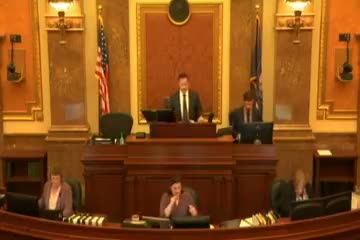
The Utah House of Representatives convened a second special session in December 2019 after Gov. Gary R. Herbert issued a proclamation calling lawmakers back to the Capitol to consider changes to tax law and one‑time appropriations for behavioral health.
Megan Allen, chief clerk of the House, read the governor's proclamation, which states, "I, Gary R. Herbert, governor of the state of Utah, by virtue of the authority vested in me by the constitution and the laws of the state of Utah, do by this proclamation call the 603rd Legislature of the State of Utah into a second special session ... on [December 2019] at 05:00PM to consider the following: 1, amendments to state law related to state and local taxes and revenue. And 2, one‑time appropriations for behavioral health." The lieutenant governor, Spencer J. Cox, then certified the proclamation and the House membership, noting an appointment in District 52.
After the proclamation and certification, the House moved quickly to adopt procedural changes intended to speed consideration of the special‑session items. Representative King moved "that the house read only the short title of bills and resolutions as they are introduced or considered unless two‑thirds of the house directs the reading of the long title," and the motion passed on a voice vote. Representative Gibson later moved to "suspend the rule requiring that all bills and resolutions remain on the calendar for one legislative day between the second and third readings," a motion the House also approved by voice vote. Both measures are procedural rules that do not change the substance of any bill but reduce the time required to advance legislation during the special session.
The speaker also announced appointments to several committees charged with official notifications: Representative Jeff Stenquist, Representative Tim Quinn and Representative Sue Duckworth were named to a committee to wait upon the governor; Representative Darren Owens, Representative Cheryl Acton and Representative Angela Romero were appointed to notify the Senate that the House was organized and ready to do business. A Senate representative informed the House that the Senate was likewise organized and prepared to proceed.
No substantive bills or appropriations were debated or adopted during the portion of the session in the transcript provided. The chief clerk's reading of the proclamation and the moves to expedite consideration were the principal actions recorded. Members recessed briefly after adopting the procedural motions while committees completed coordination with the Senate and the governor's office.
The House record shows the special session was called to address two items: amendments to state and local tax law and one‑time appropriations for behavioral health. The proclamation and certification are in the legislative record and will govern the scope of what may be enacted in the special session; details of any specific bills or appropriations were not included in the transcript excerpts provided.