Get Full Government Meeting Transcripts, Videos, & Alerts Forever!
Get email alerts on the Fetal Remains topic
No spam. Unsubscribe anytime.
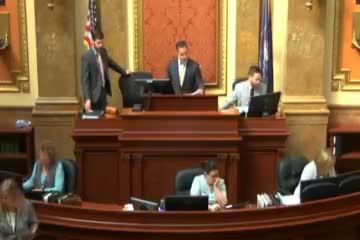
Utah House passes bill on disposition of fetal remains after heated debate over patient choice and dignity
Summary
After extended debate and a divided amendment fight, the Utah House passed third substitute House Bill 67, which requires health care facilities to offer options for disposition of fetal remains and frames the directive as protecting dignity and parental choice; final passage was 58–14.
The Utah House voted to approve third substitute House Bill 67 on March 3, 2020, a measure directing health care facilities to offer parents options for the disposition of fetal remains and to treat those remains with dignity. The bill, sponsored in the House by Representative Karianne Lisonbee, passed on a 58–14 roll-call vote and will return to the Senate for further consideration.
Lisonbee told colleagues the bill “says parents should have the right to choose the final disposition of their fetal remains” and framed it as a way to give grieving families closure. She described committee testimony in which women reported returning after miscarriages to find remains already treated as medical waste, saying that the proposal “gives the woman the right to have closure and comfort.”
The chamber spent the bulk of the floor time debating Amendment No. 2, offered by Representative Ward, which would have preserved an option for facilities’ “usual process” of disposing of biologic material when that was a woman’s explicit choice. Ward said the amendment “maintains the requirement that a woman be presented all of her options so that an honest opportunity to honor her wishes is given,” arguing it protects individual choice and can avoid additional costs for patients.
Opponents, including sponsor Lisonbee and Representative Brammer, said the amendment risked treating fetal remains as ordinary medical waste and could strip dignity from human remains. Lisonbee warned that some women who wanted to visit a burial site later had been unable to because remains had been disposed of as medical waste. Brammer framed the debate as about whether fetal remains should be treated the same as other human corpses, saying the bill’s purpose is “to provide humanity to the unborn child.”
The House divided Ward’s amendment into two sets of items for separate consideration. According to the floor record, the first division (items 1–3, which related to abortion-associated provisions) failed in an initial vote; a later division and counting procedure on items 4–5 (largely addressing miscarriages) proceeded and the floor recorded that the amendment ultimately “passes with 41 yes votes” after the procedural sequence. Supporters, such as Representative King, argued that the amendment simply preserved choice and would prevent shifting costs to patients: “This just gives more options to a woman and to her family,” King said, noting that allowing the facility process could limit additional charges.
Concerns about cost were raised by Representative Harrison, a health care provider, who warned the bill — or particular language in it — could increase costs for families and estimated a per-patient increase of $400 to $1,000 and a statewide impact “over $1,200,000.” Sponsor Lisonbee and others disputed the scale of that estimate; Lisonbee later cited a Planned Parenthood calculation that she said would amount to roughly $1.08 per fetus over certain cremation cycles to argue the bill would not produce a substantial cost increase to facilities.
Lawmakers also adopted a separate Amendment No. 3 to adjust medical terminology in line with recommendations from the Utah Medical Association and obstetricians; that technical amendment passed without recorded opposition.
The House’s passage of the bill follows committee testimony and floor debate that repeatedly framed the measure as balancing respect for human remains with preserving options for grieving parents. The immediate next step is for the bill to return to the Senate for further consideration and any concurrence on changes made on the House floor.