
Utah House advances dozens of bills on Feb. 16; key measures sent to Senate
Get AI-powered insights, summaries, and transcripts
Subscribe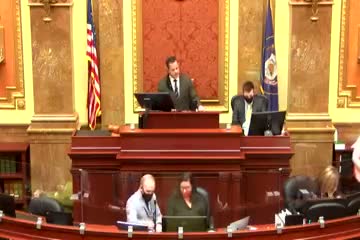
Summary
The House adopted or advanced a package of bills Feb. 16, including unanimous passage of a medical cannabis verification‑deadline change and approvals of bills on intergenerational poverty aid, diabetes prevention, mental‑health grants for first responders and tourism tax flexibility; several bills were transmitted to the Senate.
The Utah House on Feb. 16 moved a broad set of bills through the chamber and transmitted many measures to the Senate for consideration.
On the consent calendar, Senate Bill 81 — an extension of the deadline for a medical cannabis electronic verification system — passed the House 71–0. A series of committee reports and second‑reading bills were adopted early in the morning session.
On policy measures that received floor explanation and votes:
- House Bill 125 (Intergenerational Poverty Solution): Sponsor Representative Thurston described a proposal to incentivize savings and participation in education and employment for families in intergenerational poverty, including a roughly dollar‑for‑dollar match into a 529 plan that the sponsor estimated could be scaled to a $450,000 initial investment. The House passed HB 125, 70–1.
- House Bill 194 (Diabetes Prevention Program): Representative Harrison said expanding the CDC national Diabetes Prevention Program to eligible Medicaid patients is an evidence‑based, cost‑effective intervention; the pilot was described at roughly $550 per patient with about $1.3 million in matching funds available. The bill passed 69–4.
- House Bill 248 (Mental Health Support Program for First Responders): Representative Kwan explained a one‑time grant program to help agencies establish or expand mental‑health services. The bill passed 61–11.
- Second substitute House Bill 247 (Transient Room Tax amendments): Representative Albrecht said the change allows certain rural counties with national parks more flexibility to spend TRT revenue on infrastructure and public safety; the second substitute passed 73–0.
- House Bill 115 (Municipal Boundary Modifications, third substitute): Sponsors described tightened feasibility studies, notice to property owners and opt‑out windows for specified landowners; the third substitute passed and was transmitted to the Senate.
- House Bill 73 (Drug Testing Amendments, third substitute): Representative Watkins described concerns about hair‑follicle testing reliability and potential bias; the substitute limited use of that testing and allowed other tests; HB 73 passed 69–2.
- House Bill 64 (Law Enforcement Weapons Use Amendments): Representative Romero said the bill requires officers to document incidents in which an officer points a firearm or taser at an individual within 48 hours (exclusions apply for training and certain critical incidents). The bill passed 59–13.
Several other bills and concurrent resolutions were read, circled, or placed on committee calendars; the Rules Committee reported assignments for many bills. The House adopted a rules change to shorten debate time through the end of session and recessed until 2 p.m.
Votes at a glance (selected roll calls reported on the floor): SB 81 — 71 yes, 0 no; HB 234 — passed by voice/record (no recorded no votes announced); HB 125 — 70 yes, 1 no; HCR 3 — failed 27 yes, 45 no; HB 194 — 69 yes, 4 no; HB 248 — 61 yes, 11 no; HB 247 (second sub) — 73 yes, 0 no; HB 115 (third sub) — passed (transmitted); HB 73 (third sub) — 69 yes, 2 no; HB 64 (first sub) — 59 yes, 13 no.
The House recessed until 2 p.m.