Get Full Government Meeting Transcripts, Videos, & Alerts Forever!
Get email alerts on the State Of Judiciary topic
No spam. Unsubscribe anytime.
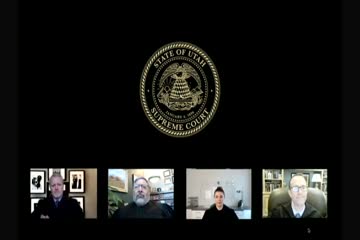
Chief Justice Durant delivers virtual State of the Judiciary, asks Legislature to fund technology and fairness office
Summary
In a prerecorded address to a virtual Utah House, Chief Justice Durant outlined how courts adapted to COVID-19, warned of jury-trial backlogs and constitutional concerns, and requested $1,935,000 ongoing and $10,000 one-time for technology and staffing, plus a new office of fairness and accountability.
Chief Justice Durant told the Utah House in a prerecorded State of the Judiciary address that the pandemic forced a rapid shift to remote operations but that courts have largely kept pace with pre-pandemic workloads while facing particular strain on jury trials.
Durant said Utah courts moved quickly to virtual hearings, noting that those proceedings have involved "over 400,000 individual participants," a scale he described as a "herculean task" accomplished by court IT staff under Heidi Anderson. He said appellate and juvenile courts have largely met pre-pandemic standards, while district courts face two notable exceptions: increasing age of pending cases and the inability to safely conduct jury trials, which he called a significant backlog and "a source of great concern." Durant emphasized the constitutional right to jury trials and the public-health obligation to protect jurors and court staff.
The chief justice asked lawmakers to fund several judicial priorities that grew out of the pandemic: additional IT developers and expanded online portal assistance, cybersecurity upgrades and greater bandwidth for rural courthouses, recruitment and retention support for court commissioners, a public outreach coordinator, and tools to give judges reliable access to out-of-state criminal history for bail decisions. Durant said the branch's request totals $1,935,000 in ongoing funding and $10,000 in one-time funding. "We are always careful as a branch not to overreach in our budget requests," he said, asking the Legislature to consider these targeted investments.
Durant also announced the creation of an office of fairness and accountability within the judiciary and the new position of public outreach coordinator, framed as part of a broader effort to build public trust and address implicit bias. "We want [those who feel left behind] to know that a court is a sanctuary," Durant said, adding that the judicial branch is devoted to treating people "with respect and dignity." He thanked members of the judiciary, judicial counsel, Judge Mary Noonan (state court administrator), and public-health partners at the University of Utah for advising on safe resumption of jury trials.
The House resolved into a Committee of the Whole to hear the address, later voted to spread the full text on the House Journal, and returned to regular business. The chief justice closed by urging cooperation across branches to honor public trust and by asking lawmakers to consider the judiciary's funding requests as they work through the session.
The House took the procedural steps to record the speech in the Journal and to dissolve the Committee of the Whole; the text of the address was placed on the House Journal following Representative Gibson's motion.