Get Full Government Meeting Transcripts, Videos, & Alerts Forever!
Get email alerts on the Bournes Pond topic
No spam. Unsubscribe anytime.
Engineer says Bournes Pond inlet widening would modestly lower nitrogen; residents warn of erosion, costs
Summary
Coastal engineer John Ramsey told Falmouth’s Water Quality Management Committee that widening the Bournes Pond inlet to about 100 feet would lower total nitrogen concentrations immediately — about 8% at the sentinel station and up to 15% in the lower estuary — while residents raised concerns about property erosion, dredging and project cost.
John Ramsey, principal at Coastal Solutions, told the Town of Falmouth Water Quality Management Committee that widening the Bournes Pond inlet as part of a coordinated bridge-replacement and shoreline project would produce immediate, measurable water‑quality benefits while also being a major construction undertaking.
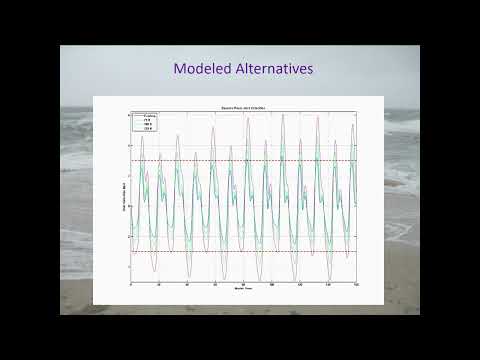
Ramsey said the town and consultants re‑surveyed bathymetry, ran circulation and water‑quality models for a range of inlet widths, and identified an engineering “sweet spot” near 100 feet where peak tidal velocities are high enough (about 3 feet per second) to mobilize sand and reduce the need for frequent dredging. At station B3 — the committee’s sentinel monitoring location — he reported roughly an 8% reduction in total nitrogen under the inlet‑widening scenario and as much as 15% improvement farther south in the pond.
Those modeled concentration changes, Ramsey said, are equivalent to removing an amount of nitrogen roughly equal to eliminating the load from about 57% of the houses in the watershed adjacent to the pond. He characterized the benefit as immediate: “As soon as you widen that inlet, you get this effect instantly,” Ramsey said, describing how changes to tidal exchange shift concentrations in the lower basin.
But residents and board members pressed project tradeoffs, sequencing and cost. Select Board member Doug Brown asked whether the road and bridge could be elevated; Ramsey replied plans are already with MassDOT and redesign would likely delay the project. Resident Anne Cloud said she opposed widening and asked for the current cost estimate, saying “I bet we’re up to 15 or more million dollars for this thing,” and asked the committee to compare that cost to the expense of installing advanced septic (IA) systems for households.
Ramsey clarified construction sequencing and dredging: the bridge removal would allow crews to access and deepen the channel inside the pond; the project’s permits (including conditions for beach and structure maintenance) will require the town to perform periodic maintenance and dredging. He also noted that inlet widening primarily improves the lower estuary, while sewering or source‑removal in the northern watershed would be needed to improve upper reaches.
Committee discussion centered on whether to prioritize sewering upstream areas or proceeding with the inlet work first. Ramsey said the two approaches are complementary: inlet widening yields immediate improvement in the lower pond, whereas sewering the watershed produces greater benefit in the north.
The committee asked staff to post Ramsey’s slides and to make cost and schedule estimates available to the public.
The committee did not take a formal vote on the inlet‑widening concept at this meeting; the presentation was for information and public comment.