
Falmouth conservation panel leans toward 200‑sq‑ft cap for sheds, fire‑pit areas and patios
Get AI-powered insights, summaries, and transcripts
Subscribe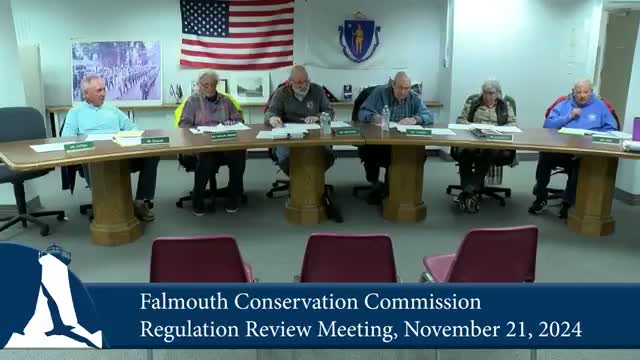
Summary
The Falmouth Conservation Commission discussed drafting a rule to limit accessory uses (sheds, fire pits, patios) in A‑zones to a cumulative 200 square feet and to require mitigation; staff emphasized the cap is a draft for public hearing, not yet final.
The Falmouth Conservation Commission on Nov. 21 debated a proposed regulatory change that would limit accessory uses in resource A‑zones — including sheds, fire‑pit seating areas and patios — to a cumulative maximum of 200 square feet.
Staff presented the draft language and the rationale: ‘‘shall not exceed 200 square feet,’’ a line in the draft that staff said would create a single, consistent standard that is simpler for field agents and property owners to apply. Staff also reminded the commission that any adoption requires public notice and a hearing before becoming effective.
Commissioners discussed how to treat cumulative impacts, enforcement challenges and what ‘‘non‑habitable’’ would mean in practice. Several commissioners and staff agreed the standard should focus on the footprint and mitigation rather than interior uses: as staff put it, the commission’s interest is the structure’s impact on the resource area rather than how a homeowner furnishes the interior. Commissioners raised examples — tents in sheds, small workshops with electricity — and asked that the rule explicitly bar conditioned or plumbed habitable spaces.
The group also debated tradeoffs: allowing a modest accessory footprint in exchange for mitigation (three‑to‑one or two‑to‑one plantings, depending on zone) could convert lawn directly adjacent to marsh into planted buffer, a net environmental gain. Dissenting remarks urged the commission to guard against homeowners converting small pervious features into larger patios or screened areas that do little for the resource.
Next steps: staff will redline the draft language for a future public meeting and schedule an advertised hearing once the commission agrees on a working text. The draft language discussed on Nov. 21 remains a staff proposal and was not adopted at the meeting.