
Falmouth ZBA closes West Falmouth Estates hearing, orders revised map after intense debate over density, septic access and construction impacts
Get AI-powered insights, summaries, and transcripts
Subscribe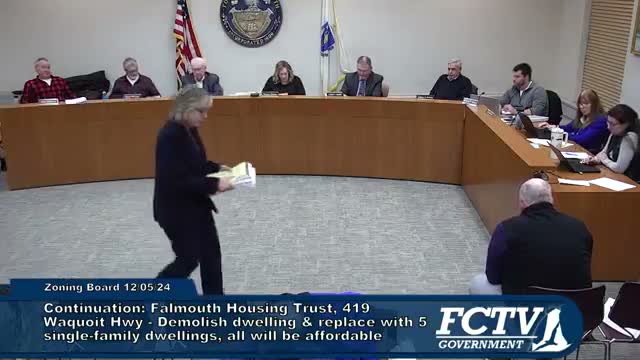
Summary
After hours of testimony, the Zoning Board of Appeals closed the West Falmouth Estates hearing and asked the developer to submit a revised plan and proposed conditions within two weeks. The discussion centered on engineering concerns about road tolerances, 700 estimated construction truck round trips, tight lot layouts and whether advanced nitrogen‑reducing septic systems (IA/NITRO) should be required now for some affordable units.
The Town of Falmouth Zoning Board of Appeals closed the hearing on the West Falmouth Estates subdivision on Dec. 5 after a prolonged technical and public debate over density, septic access and construction impacts. The board directed the applicant to file a revised site map and proposed conditions within two weeks for the board’s review on Jan. 9, 2025.
Peer‑review engineering raised construction‑scale concerns that framed the discussion. Matt Coady of Bills & Thomas, the board’s peer engineer, told the board the project requests numerous dimensional waivers and that the proposed road layout leaves "really no construction tolerance," meaning minor shifts during construction could render the finished road noncompliant. He also flagged earth‑removal impacts and estimated roughly "700 truck trips over a 2 week span," continuing: "That's why, why we figured it was worth noting." The peer review recommended before‑and‑after road condition monitoring and that the applicant accept responsibility for road repairs if heavy construction traffic damages town ways.
Board focus and public concerns: Board members repeatedly questioned whether the site is too dense for single‑family lots and raised access issues for future upgrades to advanced treatment systems that may be required by the Board of Health. Members asked whether 20 single‑family houses on the parcel — and the proposed lot coverage approaching the high 60s or 70s percent in places — create operational and maintenance risks not evident from the plan alone. Several board members urged the applicant to either reduce density or show how equipment (tanks and leaching fields) could be installed or replaced in the future.
Septic technology and costs: Engineers and board members discussed nitro/IA systems and practical installation questions. Town peer testimony and contractors raised the logistical challenge of placing heavy concrete components in tight backyards, while engineers suggested alternatives such as H‑20 plastic tanks that weigh substantially less. Board members discussed the economics: testimony included a range of figures in the hearing (standard Title 5 systems often cost roughly $15,000–$25,000 to install; a cut sheet discussed for an advanced system listed about $33,000), and members weighed whether it would be cheaper and fairer to install IA systems for affordable units up front rather than retrofitting later.
Applicant and developer response: Developer Robert Pina and his technical team defended their design and told the board they had already made numerous changes in response to prior comments and would submit additional modifications. Pina said the applicant had worked to address many concerns and that revisions to the affordable unit locations could reduce access risks. Atlantic Design engineer Rich Tabatsinski suggested relocating affordable units so their tanks and leach fields would be in front yards or otherwise easily accessible by conventional equipment.
Outcome and next steps: After public comment and extended cross‑examination of engineering details, the board voted to close the hearing while accepting the applicant’s commitment to submit a revised plan and proposed conditions for consideration. The board set Jan. 9, 2025 to review a draft decision. The ZBA also indicated potential conditions it may consider, including a requirement for pre‑ and post‑construction road condition documentation, escrowed funds to cover future upgrades if needed, and clearer lot‑line adjustments to avoid lot lines running through parking areas.
What remains unresolved: The board did not vote on waivers or final approval. Outstanding issues that must be resolved by submission and board review include final road layout tolerances, exact lot coverage numbers, placement and feasibility of septic/IA systems, how to protect affordable homeowners from disproportionate future retrofit costs, and whether any density reductions are necessary to meet the town’s engineering and long‑term maintenance standards.