Get Full Government Meeting Transcripts, Videos, & Alerts Forever!
Get email alerts on the Governance Handbook topic
No spam. Unsubscribe anytime.
Falmouth Select Board holds handbook workshop; consultant urges members to ‘stay in your lane’
Summary
At a Dec. 7 workshop, the Falmouth Select Board and town staff worked with presenter Bill Synod to begin drafting a town-specific Select Board handbook. Key topics included liaison policies, committee coordination, the code of conduct, and clarifying channels between committees and town staff.
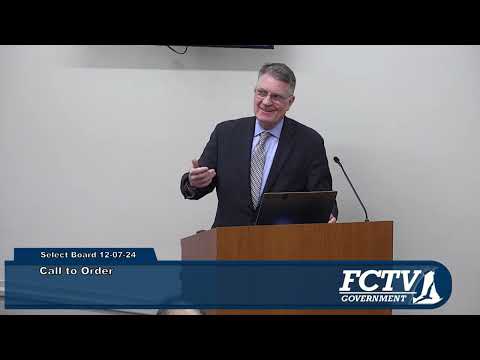
FALMOUTH — The Falmouth Select Board on Dec. 7 held a workshop-style training with presenter Bill Synod focused on governance practices and drafting a Town of Falmouth Select Board handbook.
Synod framed the session as interactive training and told members the workshop’s aim was to remind rather than instruct: “The whole idea of this presentation is to make you better selectmen,” he said, and repeatedly urged one core principle: “stay in your lane,” meaning board members should set policy but avoid directing day-to-day administration or instructing department heads without going through the town manager. He warned that actions exceeding lawful authority can be “null and void.”
The session included a brief review of legal underpinnings, a discussion of the select board’s role versus that of other elected boards and the town manager’s office, and a close look at the town’s code of conduct. Synod recommended the board produce a Falmouth-specific handbook based on the Massachusetts Municipal Association materials and local practice to clarify recurring questions, particularly about liaison duties and communications between boards and staff.
Board members described a range of backgrounds and the practical frustrations that bring residents into service, from school leadership and nonprofit work to business and veterans’ service. Those origin stories set a collaborative tone for the practical portions of the session, where members and staff discussed how committees currently use liaisons, when committees should contact staff, and how the select board can increase transparency without creating unauthorized deliberations.
Town staff and several board members said committee-to-staff communications remain a pain point. A recurring theme was the need to ensure committees do not bypass the manager’s office or directly instruct department staff; staff described cases where such contacts created confusion for department heads. Synod and the town team recommended stronger written guidance for liaisons and suggested cross-referencing that guidance in both the select board and committee handbooks.
On next steps, the board agreed to draft a local handbook and to align committee guidance. Select Board member Bob (name as provided in meeting) volunteered to produce an initial draft using the Lexington handbook as a starting point and incorporate Falmouth’s existing code of conduct and liaison policy. Synod offered to review the draft when ready.
Procedurally, the meeting concluded with a motion to adjourn that was seconded and approved by voice vote.
The workshop emphasized clearer channels and predictable processes — Synod’s priority was reducing ad hoc or informal practices that can undermine staff, generate legal risk under the Open Meeting Law, or confuse residents about which body is responsible for which decisions. The handbook project is intended to document those expectations so committees, staff and residents have a shared reference.