
Falmouth ZBA moves forward with 419 McCoyte Highway affordable housing; applicant to submit draft decision
Get AI-powered insights, summaries, and transcripts
Subscribe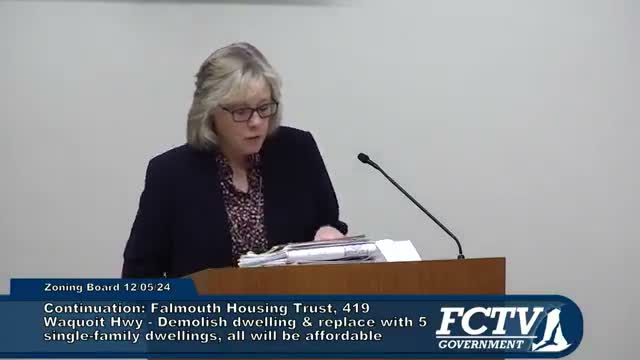
Summary
The Zoning Board of Appeals heard a continuation of a five‑lot affordable housing proposal at 419 McCoyte Highway, pressed the applicant on septic, drainage and maintenance plans, and agreed the applicant may submit a proposed draft decision for board review on Jan. 9, 2025.
The Town of Falmouth Zoning Board of Appeals on Dec. 5 heard renewed testimony on a five‑lot affordable housing proposal at 419 McCoyte Highway from the Falmouth Housing Trust, with the board and peer reviewers focused on stormwater, septic technology and long‑term maintenance costs.
Laura Moynihan, executive director and in‑house counsel for the Falmouth Housing Trust, told the board the project team addressed a recent engineering peer review and added catch basins, boundary monuments and other details. She said the state Department of Transportation has moved the project's curb cut request to a 75% review stage. “We have a fundraising need of about $550,000 for this project,” Moynihan said, adding that rising construction costs make timing critical.
Why it matters: The proposal is for five permanently affordable homes. The board’s technical questions about treatment of wastewater, future operational costs and site access will affect whether units need advanced nitrogen‑reducing treatment now or could be retrofitted later — an economic concern for low‑income buyers.
Board and staff questions centered on septic choices and long‑term maintenance. Moynihan said the applicant is proposing individual advanced treatment (NITRO/IA) systems for each lot as a voluntary water‑quality protection measure, and argued that shared systems carry additional costs and governance complexity (generators, pumps and homeowner association dues). She estimated individual systems would cost “around 40” (thousand dollars) each based on bulk pricing, and said the trust would create an escrow and attempt to negotiate bundled testing and maintenance to lower operating costs.
Peer and board concerns: Board members and the board’s peer engineer asked how future changes in local or state rules might affect the project, and how long‑term testing and maintenance costs would be covered. The board urged clarity on covenant language and suggested nominal annual assessments to fund inspections. Moynihan offered to provide covenants and to submit a proposed draft decision to assist staff workload.
Process outcome: The board and applicant agreed on a process to keep the project on a compressed timeline. Moynihan offered to submit a proposed draft decision and any requested plan changes; the board agreed to review a draft decision on Jan. 9, 2025. The ZBA indicated it may condition approval on the submission of covenants, monument placement and other standard items before any lot conveyance.
What’s next: The applicant will file the proposed draft decision, revised plan materials and draft covenants for the board to consider at the Jan. 9 meeting; any formal vote will follow the board’s review of those materials.