Get Full Government Meeting Transcripts, Videos, & Alerts Forever!
Get email alerts on the Wetlands And Coastal Regulations topic
No spam. Unsubscribe anytime.
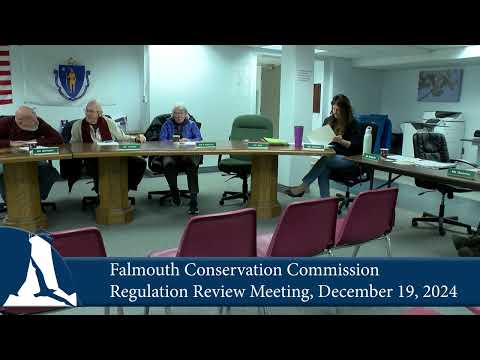
Falmouth conservation panel outlines draft rules for small sheds, fire pits and V‑zone enclosures
Summary
The Conservation Commission directed staff to draft regulations allowing small sheds (proposed cap: 200 sq ft) and to develop fire‑pit standards (discussed limits ranged from about 50 to 176 sq ft) while scheduling a January presentation on V‑zone and 'limit of moderate wave action' mapping; staff will return with refined language and public‑hearing drafts.
The Conservation Commission on Dec. 19 instructed staff to draft a set of regulation changes covering small sheds, outdoor fire‑pit areas, V‑zone enclosures and several operational clarifications aimed at making permit decisions more consistent.
Staff told the commission they will propose a narrow working definition of 'shed' — "a structure not to exceed 200 square feet" — and move location restrictions such as "not in a naturally vegetated area" into the regulation text rather than into the definition. "A structure not to exceed 200 square feet," staff said when summarizing the draft language the commission asked them to develop.
Commissioners and staff also spent substantial time on fire pits and whether to set a fixed area, a diameter limit, or handle cases individually. Participants raised several figures in discussion — a 12‑foot diameter (roughly 108 sq ft), a 15‑foot diameter (≈176 sq ft), 150 sq ft, and smaller proposals such as 50 sq ft — and emphasized that any allowed fire‑pit area should use pervious surfacing and include safeguards so it not be converted later into an impervious patio or other permanent structure. "We only care about the footprint," staff told the commission when defending a focus on size and location rather than interior use.
The commission also scheduled a dedicated January meeting on V zone matters. Staff said they will invite Shannon Holtz (county) and Gary Street to present on the interaction of FEMA mapping, the state building code, and a mapped "limit of moderate wave action" (LMWA) that has been used in draft state and local materials to identify areas with smaller but potentially damaging wave action. Commissioners sought clarification about how LMWA differs from FEMA velocity zones and AE flood zones and agreed to hear Shannon's presentation before finalizing local regulatory language.
Other items staff will incorporate into draft regulations include: formalizing a 10‑foot no‑structure setback in the text where previously it appeared only in preambles; clarifying when small projects may be handled via an RDA (staff said the current practice is to allow mitigation under an RDA for smaller work and to require a Notice of Intent once mitigation exceeds the draft threshold); and requiring survey plans when view‑corridor (VISTA) allowances exceed a 25‑foot baseline so that percentage rules can be applied fairly across irregular lots.
Staff also raised related compliance topics the commission asked them to address in drafts, including how to treat permanent three‑dimensional additions to previously permitted patios (for example masonry pizza ovens or outdoor kitchens) and an increase in decorative retaining walls being added during construction. Commissioners expressed a preference to treat portable or removable features (rolling grills, temporary pits) differently from permanent masonry or structural additions that could divert floodwaters or alter wave impacts.
On docks, staff said the bylaws currently rely on proof of continuous use since the late 1970s to qualify for grandfathering and that proving existence back to 1978/79 is often difficult. Commissioners asked staff to consult counsel about alternative proof periods or an organized amnesty process similar to a 1991 state program that granted long licenses to those who applied during a window.
What happens next: staff will draft concrete regulatory language that reflects the commission's guidance and present it for further review and a public hearing schedule; Shannon Holtz and Gary Street will present on V‑zone and LMWA issues at the January meeting; vista‑pruning language is expected back in February.