Get Full Government Meeting Transcripts, Videos, & Alerts Forever!
Get email alerts on the Tax Credit Refund topic
No spam. Unsubscribe anytime.
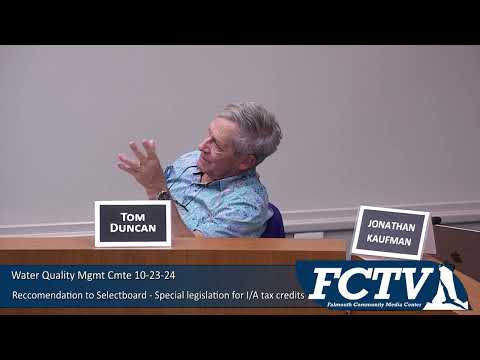
Falmouth committee asks Select Board to press state to make septic tax credit refundable
Summary
The Water Quality Management Committee voted to ask the Select Board to support changing the Massachusetts DOR Schedule SC credit from nonrefundable to refundable, adding explanatory language referencing MassDEP-designated nitrogen‑sensitive areas and moving the rationale into an attachment for Beacon Hill review.
The Town of Falmouth Water Quality Management Committee voted to ask the Select Board to support state legislation that would change the Massachusetts Department of Revenue’s Schedule SC tax credit from nonrefundable to refundable, the committee announced after a voice vote.
Committee members framed the change as a way to ensure homeowners required to install advanced nitrogen‑reducing septic systems can receive reimbursement from the state regardless of tax liability. "All we're doing is changing it from nonrefundable to refundable," one committee member said during debate, arguing the change would make the benefit accessible to low‑income and fixed‑income households who otherwise could not use the credit.
Members debated whether to limit the refundable credit to parcels inside town‑defined geo boundaries. A committee amendment to reference "MassDEP‑designated nitrogen sensitive areas" was adopted to use language familiar to state regulators and to narrow the fiscal exposure. The committee also voted to move an explanatory sentence about geo boundaries into an attached explanation rather than including it in the legislative request itself.
Supporters said a narrower, targeted refundable credit would be more palatable to Beacon Hill because it reduces statewide cost exposure; other members warned that too‑narrow a scope could later bind local flexibility. The committee discussed outreach to regional partners and legislative sponsors and noted that state lawmakers and the town council had urged keeping the proposal workable for the state legislature.
The committee’s recommendation will be forwarded to the Select Board for consideration; committee members said the Select Board’s support would help pursue the legislative change in collaboration with towns and local legislative advocates. The committee did not record a roll‑call vote; the motion passed by voice vote.
Next steps: the committee will present the amended recommendation to the Select Board and continue coordinating with municipal and regional partners about legislative strategy and potential cost estimates.