Get Full Government Meeting Transcripts, Videos, & Alerts Forever!
Get email alerts on the Watershed Planning topic
No spam. Unsubscribe anytime.
Falmouth advisory panel outlines watershed permit plans to cut nitrogen; sewer outfall and denitrification options detailed
Summary
Steven Rafferty, chair of Falmouth’s Water Quality Management Committee, presented preliminary watershed plans tied to Massachusetts DEP watershed permit rules, outlining a mix of sewering, advanced on‑site systems and a planned ocean outfall to reduce nitrogen loads in local estuaries and a multi‑year implementation timeline.
Steven Rafferty, chair of the Town of Falmouth’s Water Quality Management Committee, told the Zoning Board of Appeals that the committee’s preliminary watershed plans target reductions in nitrogen loading across the town’s estuaries under recently promulgated Massachusetts DEP watershed permit regulations and Title 5 revisions.
“We filed a notice of intents, one for each of the 14 estuaries,” Rafferty said, explaining the committee chose a staggered approach so municipalities do not have all monitoring and plan‑preparation obligations at once. He described the regulatory backdrop, including total maximum daily limit (TMDL) sentinel targets: “For example, in Great Pond, the nitrogen concentration should not be above 0.4. It’s currently in the 0.8 range,” Rafferty said.
Rafferty explained the tradeoffs local leaders face in achieving reductions. The state’s planning arithmetic uses a 35 mg/L baseline for sewage nitrogen; advanced on‑site treatment systems are expected to achieve roughly 10 mg/L, giving a roughly 25 mg/L credit versus the baseline. “The state has decreed that the magic number is 35 mgL of nitrogen in sewage,” he said, and DEP expects ‘‘best available’’ advanced systems to produce effluent “of 10 milligrams or less.” He noted that some proprietary systems are in provisional approval stages and need three years of performance data for full approval.
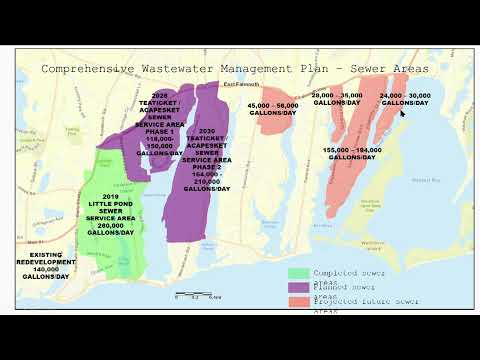
On sewering and regional infrastructure, Rafferty said the town’s comprehensive wastewater management plan (CWMP) and preliminary watershed plans assume proposed sewer areas and a planned ocean outfall. He said officials are sizing the outfall for roughly 2 million gallons per day; “the plant is currently 1.7,” he said, which leaves some capacity that could be targeted to reduce the number of on‑site advanced systems required in particular neighborhoods.
Board members pressed Rafferty about impacts on housing developers and affordable units. Tony Petrucci and others asked whether requiring advanced systems now — instead of later when neighborhoods are regulated — would simply shift tens of thousands of dollars in cost to affordable homebuyers. Rafferty acknowledged the concern and described current state tax credits: “the state modified regulation ... now says if you are a primary homeowner and your system is deemed to be in failure, you can get tax credits up to $18,000 spread out” — but he said the credits are often inaccessible or smaller for lower‑income homeowners with limited state tax liability.
The committee is considering policy proposals to expand or convert the existing tax credit into broader grants and said it will seek legislative engagement across Cape Cod to make assistance more uniformly available. Rafferty said the committee has completed preliminary plans for 11 of 14 estuaries and expects all preliminary watershed plans to be finished by early November; guidance on implementing geo‑zones is scheduled for November–December, with a committee recommendation to the Select Board targeted for January.
Rafferty emphasized the mixture of approaches the town will likely use: sewering where feasible, targeted advanced on‑site systems elsewhere, and selective use of engineered options such as permeable reactive barriers. He told the board that the technical and political steps — engineering certification, Board of Health rules, and town meeting or Select Board decisions — remain to be worked through.
Next steps: the Water Quality Management Committee will finalize preliminary watershed plans, draft implementation guidance on geo‑boundaries and variance processes in November–December, coordinate with the Board of Health, and present recommendations to the Select Board in January. The committee said it expects the suite of watershed plans to be completed and staged over a multi‑year timetable (several watersheds grouped and sequenced rather than all at once).