Get Full Government Meeting Transcripts, Videos, & Alerts Forever!
Get email alerts on the Fund Balance topic
No spam. Unsubscribe anytime.
Staff explain fund-balance reconciliation and say mill-levy failure likely curbs planned expansion, not immediate cuts
Summary
District staff walked the board through fund-balance accounting, reconciled a governmental fund-balance near $297 million with a negative net position driven by long-term pension liabilities, and said a failed $34 million mill levy will likely limit program expansion but not require immediate major cuts.
Aaron (name used in the transcript), who led the fund-balance presentation, told the board that governmental fund balance and government-wide net position measure different things and that the district's negative net position is driven principally by long-term pension and OPEB liabilities presented on the government-wide statements.
Aaron and auditor John Paul Lechavaglia explained the mechanics: capital assets and long-term pension liabilities are included in government-wide net position, while governmental fund balance excludes capital assets and focuses on current assets such as cash. The presentation showed a governmental fund-balance figure in the neighborhood of $296'297 million and a reconciled net position of about -$95 million after adding back capital assets, debt and pension liabilities.
Key numbers discussed: Lechavaglia said the net pension liability for FY2024 was "just a little less than $800,000,000." Aaron said the audit year produced an operating surplus across funds of roughly $24,600,000. Board members asked how the recent mill-levy failure would affect those metrics; Aaron said a passed mill would have generated about $34,000,000 for the coming budget year, and that because the district has an operating surplus and reserves the immediate need for cuts is limited, though planned expansions such as targeted salary increases or CTE operating increases likely will not proceed.
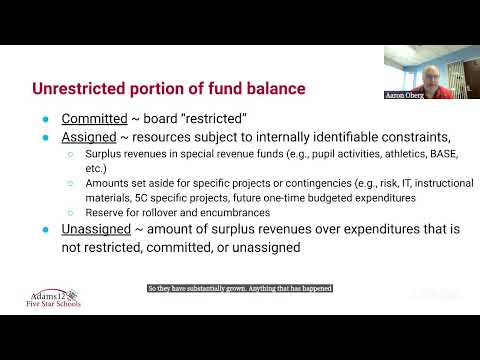
Aaron reviewed fund-balance categories and policy constraints: nonspendable, restricted (for example, USDA nutrition funds or bond proceeds required by bond covenants), board-assigned reserves, and unassigned amounts. He said the district maintains board policy that unassigned fund balance should be between 4% and 8% of revenues and that the district has set aside specific reserves, including a $5,000,000 risk reserve and assignments for instructional materials and IT needs.
What comes next: staff said they would incorporate these figures into next year's budget planning, consider the impact of one-time versus ongoing revenues (for example, ESSER funds were characterized as one-time), and report back to the board on any necessary adjustments.