Get Full Government Meeting Transcripts, Videos, & Alerts Forever!
Get email alerts on the Agriculture Programs topic
No spam. Unsubscribe anytime.
Extension and NRCS updates: EQIP/CSP obligations, a new Emergency Commodity Assistance Program, and regional dairy workshops
Summary
NRCS and Extension staff updated the committee on EQIP/CSP contract work and sign‑ups; a new federal Emergency Commodity Assistance Program will send prefilled applications to producers, and regional Badger Dairy Feeding Workshops — provided bilingually — are planned.
Sawyer (substituting for the county conservationist) reported the conservation office is finalizing EQIP contracts (about nine obligated) and is preparing to assess roughly 25 CSP (classic) applications for preapproval and ranking. He reminded the committee of contract deadlines (EQIP obligations due April 4; CSP assessments targeted by April 25).
Separately, a county Extension staff member (Matt) briefed the committee on recent federal action: a continuing resolution keeps funding into August, and USDA has launched an Emergency Commodity Assistance Program funded in December. Matt said the new program will prefill applications from producers' 2024 crop reports and mail them to producers; applicants can review, correct if needed, and sign. Payment limits are $125,000 per producer and the program covers a specific set of commodities (corn, soybean, oat, wheat, barley); alfalfa and vegetables were excluded.
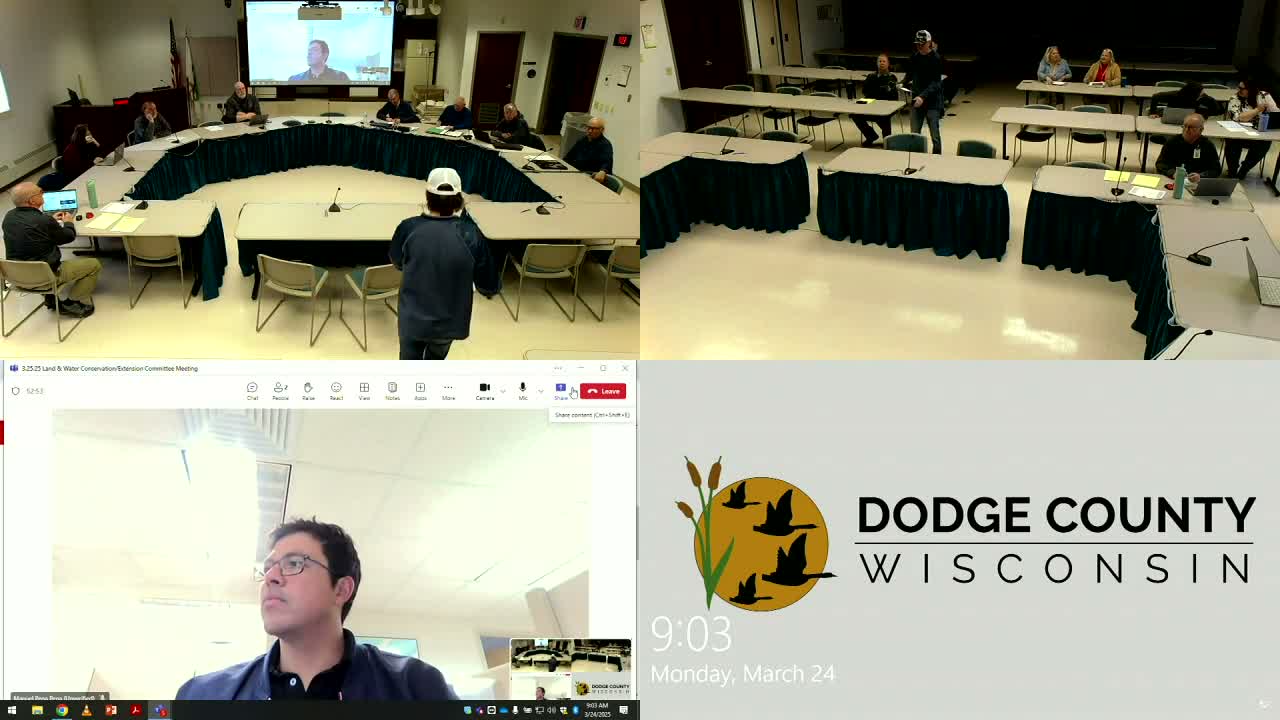
A recorded segment and discussion promoted the Badger Dairy Feeding Workshops; Manuel Pena, a bilingual regional dairy educator, explained the workshops' aim: bring research on nutrition to feeders and herd-management staff and deliver content in Spanish where needed. Pena said Extension is producing bilingual materials and that five events are scheduled through April with online registration at dairy.extension.wisc.edu.
Committee members asked practical questions about enrollment, future funding uncertainty beyond the fiscal year, and the simplified one‑page application design for the Emergency Commodity Assistance Program. Staff said they expect to start mailing prefilled applications and to begin processing payments soon; producers are encouraged to contact the office for appointments.