Get Full Government Meeting Transcripts, Videos, & Alerts Forever!
Get email alerts on the Private Wells And Septic topic
No spam. Unsubscribe anytime.
Jefferson County advises Conifer residents on private-well testing and septic maintenance
Summary
Jefferson County Public Health walked homeowners through recommended private-well tests, treatment options and septic-system maintenance, stressing testing at well completion, property transfer and for bacteria/nitrate concerns, and recommending local resources for labs and courier testing.
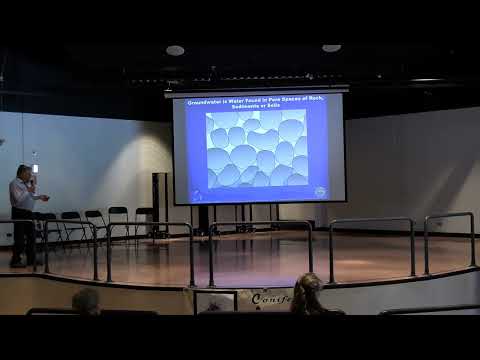
Conifer — Jefferson County Public Health outlined recommended testing and maintenance practices for private wells and on-site wastewater systems at a Conifer Area Council town hall.
Roy Laws, an environmental health specialist with Jefferson County Public Health, told attendees that private well owners are not required by law to test but that testing is important for health and property reasons. "For the most part, yeah. Water quality is is pretty good most of the time," Laws said, adding that localized problems do occur and that baseline testing at well completion, bacteria and nitrate checks, and testing during property transactions are prudent steps.
Laws described common local contaminants — bacteria (total coliform and E. coli), nitrate from septic systems or livestock, naturally occurring fluoride and (in some geologic areas) uranium — and noted that testing needs vary by context (mining proximity, service-station leaks, agricultural corrals). He advised residents to compare results to Colorado safe drinking water standards and recommended private and state labs for testing, mentioning that Jefferson County Public Health runs a courier to the state lab for roughly $10 per sample.
On treatment, Laws reviewed disinfecting methods (shock chlorination, ultraviolet) and mineral-removal options (ion exchange, cartridge filters, reverse osmosis), and he distinguished point-of-use (under-sink) systems from whole-house systems on cost and maintenance. He emphasized that treatment systems require ongoing maintenance and filter replacement.
Turning to septic systems, Laws explained the basic process (septic tank primary treatment followed by soil dispersal), the importance of proper sizing and retention time (example: a three-bedroom house needs roughly a 900-gallon tank for a 48-hour retention), and practical protections — divert surface water, avoid driving or building over leach fields, get permits for repairs, pump tanks every 3–5 years and inspect annually.
Laws closed by listing resources — Jefferson County Public Health materials, CDPHE and EPA guidance, private certified labs and the ‘Well Owner’ online resources — and urged residents to contact county environmental health staff with specific questions.