Get Full Government Meeting Transcripts, Videos, & Alerts Forever!
Get email alerts on the Septic To Sewer Grants topic
No spam. Unsubscribe anytime.
Lake Clarke Shores seeks state water-quality grants tied to septic-to-sewer commitment; council discusses resident vote
Summary
Consultant Richard Repinsky told the Town of Lake Clarke Shores council the town has applied for three Florida Department of Environmental Protection (FDEP) water-quality grants — including a $7 million Michael West component and a $6 million vacuum-collection backbone — and a $10 million lake-cleanup request. Repinsky said FDEP wants a clear community commitment to converting septic systems to central sewer before funding the cleanup; council members discussed a nonbinding resident poll to guide policy.
Consultant Richard Repinsky told the Town of Lake Clarke Shores council on Oct. 8 that the town has submitted three applications to the Florida Department of Environmental Protection’s water-quality improvement grant program tied to the municipality’s 4E plan and efforts to address prior sewer spills.
Repinsky said the top-priority projects are a Michael West component of the septic-to-sewer conversion (a $7,000,000 project for which the town is asking a 50% match), a vacuum-collection backbone system (about $6,000,000, also at a 50% match) and a proposed lake cleanup for impacts tied to earlier sewer spills. He told the council the cleanup proposal asks FDEP for roughly $10,000,000 and emphasized that the department is reviewing the town’s overall commitment to central sewer before approving large cleanup funding.
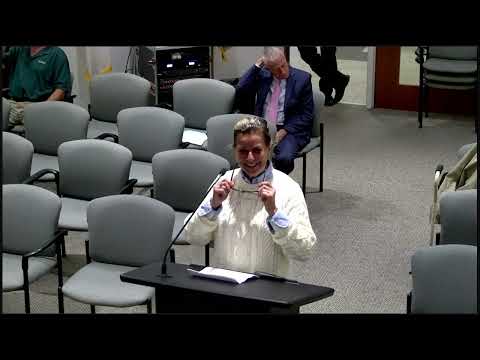
"They're asking, 'Why would we give you $10,000,000 to clean up your lake if you're not committed to converting septic to sewer?'" Repinsky said. "We have to communicate what this community wants to do. One way or the other, it's not me — I need clear direction or a policy to present to FDEP."
Why it matters: Repinsky said FDEP evaluates grant requests holistically and will look for evidence the town intends to follow through on infrastructure changes that reduce ongoing pollution. Several council members and residents said cost is a central barrier and urged the town to seek federal and state funding so residents are not charged unaffordable per-household conversion costs.
Public comment and council response: Resident Tim Daughtry urged the town to pursue outside funding aggressively and warned individual homeowners cannot absorb full conversion costs. "There's just no possible way without significant funding coming from outside of this town," Daughtry said at public comment. Several council members later discussed hosting a nonbinding community poll to show commitment and to capture preferences under different cost scenarios (for example: free hookups, $20,000 per home, or $40,000 amortized over 30 years).
What the town can ask for: Repinsky outlined three potential legislative or funding priorities for the coming session — continuation of septic conversion funding, other water-quality projects, and an amendment to the enclave-annexation statute that could restore revenue to the town if interlocal agreements are not promptly approved by Palm Beach County.
Next steps: Repinsky asked the council to give a clear policy direction at a future meeting or to allow a straw poll so he can continue advocacy in Tallahassee and to FDEP. Council members signaled they will discuss options, framing a potential poll to include the ~702 homes that could be affected and to vary cost scenarios to measure public support.
Provenance: Material summarized from the Repinsky presentation and subsequent Q&A and council discussion (presentation began at the consultant’s remarks and continued through technical Q&A and council comments).