Get Full Government Meeting Transcripts, Videos, & Alerts Forever!
Get email alerts on the Consumer Finance topic
No spam. Unsubscribe anytime.
Pennsylvania educator urges planning for big purchases, warns against predatory lenders
Summary
Katrina Boyer of the Pennsylvania Department of Banking and Securities told a Moms on the Money Trail session that buyers should budget for new payments, check credit reports, document identity-theft recovery, and avoid credit-repair and payday scams; she directed participants to CFPB, HUD and state licensing resources.
Katrina Boyer, the investor education coordinator at the Pennsylvania Department of Banking and Securities, urged participants in a Moms on the Money Trail workshop to build realistic budgets before buying a car or a home and to use federal and state resources to avoid scams.
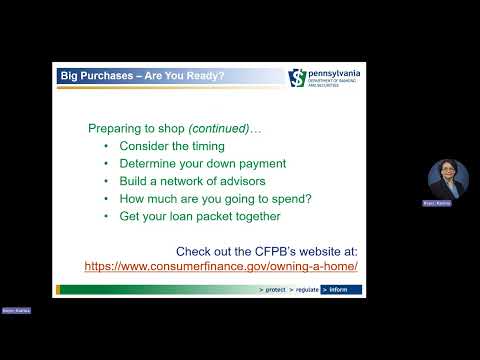
"Can you afford that new payment?" Boyer asked attendees, urging a new spending plan that includes taxes, insurance and likely maintenance. She cautioned that lender "preapproval" may be higher than what a household can reasonably afford: "Just because you're preapproved to buy a $500,000 house does not mean that you should run out and spend that maximum dollar amount." She recommended using consumerfinance.gov/owningahome and annualcreditreport.com to research steps and check credit reports (the latter provides reports, not scores).
Boyer gave numerical examples to show how credit and down payments affect long-term costs. Using a $25,000 auto loan at about 5% APR, she said a zero-down payment could yield a roughly $542 monthly payment, while 10% down (about $2,500) could lower the payment to about $495 and save roughly $330 in interest over five years. For a $250,000 mortgage at about 5.9%–5.98%, she illustrated that putting 10% or 20% down significantly lowers monthly payments and private mortgage insurance (PMI) costs, and that 20% down eliminates PMI and produces large interest savings over 30 years.
On credit hygiene and fraud recovery, Boyer advised pulling reports from all three major bureaus — Equifax, TransUnion and Experian — and verifying names, addresses, employers and payment history. If a participant is an identity-theft victim, she recommended filing a police report and contacting fraud or security departments at affected companies; she said keeping a dated notebook of disputes, who was called and what was said can help when applying for loans.
Boyer warned about credit-repair scams and illegal or risky tactics: companies that guarantee fixes for high upfront fees, or that encourage disputing valid debts or misrepresenting income, can expose consumers to legal trouble. "If a company tells you to dispute all of the bad remarks on your credit report, those are some pretty hefty fraud charges you're gonna be facing," she said.
She also urged caution with seemingly easy no-down-payment offers, especially for cars, and described predatory-mortgage practices — higher-than-normal rates, excessive points (one point = 1% of the loan), required add-on products, and inflated appraisals that allow borrowers to qualify for loans they cannot afford. Before signing, she recommended borrowers check a mortgage professional's license and disciplinary history via Pennsylvania Department of Banking and Securities resources or NMLS Consumer Access.
On emergency borrowing, Boyer stated that traditional payday loans and car-title loans are not legal in Pennsylvania and cautioned about extremely high APRs, which she described could reach hundreds of percentage points in rollover schemes. As alternatives in short-term crises she recommended contacting utilities and lenders early, seeking assistance from nonprofits or religious organizations, borrowing from family, or dialing 211 for local referrals.
Boyer closed by directing participants to HUD housing counselors for first-time-homebuyer guidance and to resources she would include in the session PDF and recording. "It has been a pleasure presenting for you today," she said before transitioning to questions.
The workshop focused on practical steps consumers can take before making a large purchase — revise your monthly budget, review and correct credit reports, document any fraud, avoid firms that promise guaranteed credit fixes, and compare loan offers — and ended with an invitation to continue with discussion and Q&A.