Get Full Government Meeting Transcripts, Videos, & Alerts Forever!
Get email alerts on the Pond Management topic
No spam. Unsubscribe anytime.
Concord task force narrows pond-management recommendations, flags costs and next steps
Summary
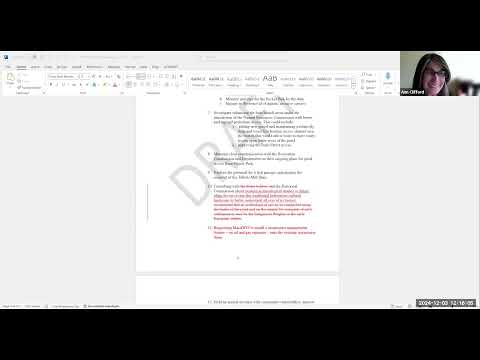
Task force members recommended removing large-scale DASH and broad drawdown from the draft Warner's Pond plan, favoring targeted maintenance, consulting a pond-management firm, and exploring a fish passage; members discussed contractor cost estimates, an approximate 13-acre pond size, and available town funds.
Speaker 1 (Task force member) said the task force is still consulting with EA about the end of their contract and asked EA to estimate engineering costs for a fish passage; EA has promised to return with a proposal and cost estimate. Members agreed to change all references from “fish ladder” to “fish passage” to reflect a nature-like fishway rather than a structure, a change Speaker 2 proposed and the group accepted.
The group's most detailed debate focused on DASH aquatic-vegetation harvesting and whether to recommend it in the final report. Speaker 2 described outreach to towns and a contractor, naming New England Aquatic Services as one contact: “they typically can do between a quarter acre and a third of an acre a day” and the contractor quoted “just under $3,000 a day,” Speaker 2 said. The draft Harvard estimate of roughly $20,000 per acre was described as a rough figure. Speaker 2 said multiple municipal contacts reported annual or repeated treatments are typical and that densities can rebound without ongoing work.
Speaker 1 shared a map and said Warner's Pond totals about 13 acres, making whole-pond DASH financially impractical; using a $15,000–$25,000 per-acre range would put a full-pond DASH cost roughly between $195,000 and $325,000. Given those figures and feedback from contractors, the group concluded large-scale DASH should be removed from the primary recommendations. Instead, the draft will say the pond-management plan should consider small-area DASH for maintenance (for example, the channel from the boat launch to Scout Island) and that the town should retain a pond- or lake-management firm to produce a formal plan before committing to multi-year control programs.
Members also discussed alternatives such as hand-picking and localized drawdown for shallow shorelines; however, attendees noted drawdown had largely been ruled out in prior EA materials and that it was not raised by DASH contractors as part of typical treatments. Several speakers cautioned that targeted approaches would require further study to estimate recurring annual costs.
On budget and timeline, Speaker 1 said roughly $3,000,000 in town-allocated funds remain associated with the project. Speaker 5 (Carla Reed, member of the finance committee) asked when the task force would present the proposal to the town and noted FINCOM’s preliminary guidelines are asking for substantial budget reductions. The group tentatively agreed to present a cleaned-up draft at a meeting on the 17th and to circulate a final version after editorial changes.
The task force agreed to: (1) change wording to “fish passage,” (2) delete large-scale DASH and drawdown as primary recommendations while leaving small-area DASH on the table, (3) instruct staff to consult a pond-management firm for a formal plan and cost estimate, and (4) circulate a final draft and supporting PowerPoint to members before the scheduled presentation.