
Task force debates 'no action' management plan for Warner's Pond; members push for clearer metrics and five-year review
Get AI-powered insights, summaries, and transcripts
Subscribe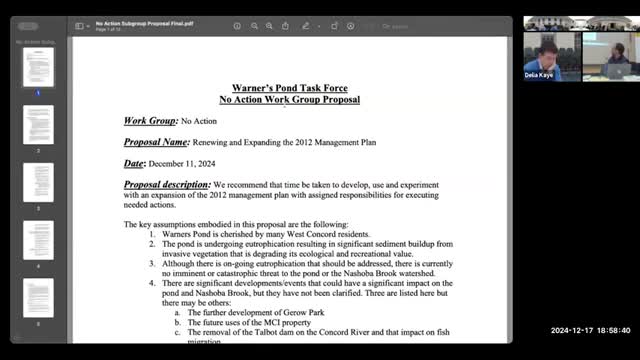
Summary
Members said the management-based 'no action' alternative should be clarified as an active plan (not doing nothing), include cost estimates, show how it differs from the status quo, and include a formal five-year reassessment.
A 'no action' or management alternative under review by the Town of Concord Waterfront Task Force drew both support and criticism Monday as members urged clearer language about objectives, timelines and costs.
Several members described the 'no action' proposal as a management plan — not passive inaction — that would institute regular stewardship, invasive-species control and annual monitoring but stop short of major capital work. One member said the draft looks "like doing what we've been doing since 2010" and pressed for clearer articulation of how the plan differs from the status quo.
Many members recommended adding a formal review date. "We say this proposal should be reviewed no later than within five years," a member suggested, a change the group said would help avoid an open-ended 'bridge' without clear decision points.
Why it matters: The management alternative is comparatively lower cost but carries uncertainty about how much it will improve ecological conditions. Members warned that describing it as "no action" risks confusing the public and urged a short section that explains "what's new and different" compared with past practice.
Points raised: - Timeline and review: Members recommended a five-year formal reassessment with an annual monitoring schedule to decide whether to escalate to dredging or dam removal. - Costs and scope: Several members asked for more explicit annual and 10-year capital outlook numbers so the public can compare alternatives on an apples-to-apples basis. - Biological outcomes: Members asked that the plan specify how it would or would not address fish passage, invasive plants and sediment/arsenic questions.
Next steps: Workgroup and staff will incorporate edits clarifying the plan's distinct actions (stewardship activities, monitoring frequency and review triggers), and add as much cost information as feasible before the January review rounds.