
Concord Finance Committee adopts amended FY26 guideline after town and school requests; 10–3 vote
Get AI-powered insights, summaries, and transcripts
Subscribe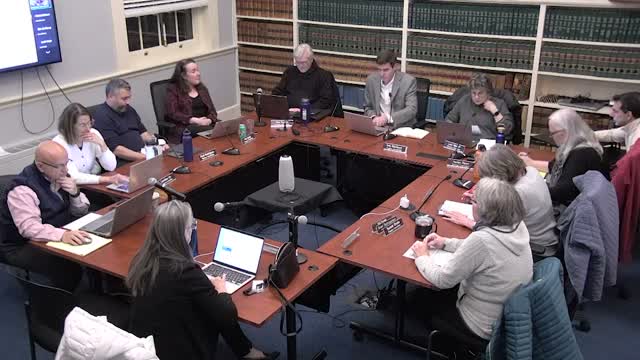
Summary
The Concord Finance Committee voted 10–3 to adopt an amended FY26 guideline that splits additional tax‑capacity between Concord Public Schools and town operations and asks the town and schools to collaborate on efficiency plans; committee chair will circulate a formal memo to leadership.
The Concord Finance Committee voted to adopt an amended final budget guideline for fiscal 2026 after hearing from school and town leaders and a member of the public, approving the compromise 10–3.
The committee’s amendment sets a blended guideline that allocates modest additional room to both the schools and the town: Concord Public Schools (CPS) at 2.4% over last year, the Concord‑Carlisle regional high school (CCRSD) unchanged at the preliminary 3.48%, and the town at 2.85% — producing an overall increase of about 2.79%. Committee members said the compromise is intended to balance near‑term budget pressures with preserving unused levy capacity and avoiding or delaying an operational override vote.
Why it mattered: school officials told the committee that while CCRSD can meet the preliminary guideline, CPS would struggle to meet a lower 1.8% target without program or staff reductions and therefore had requested a higher target (about 2.7%). Town leadership said salary increases and contract settlements are the principal cost drivers and asked the committee to consider 3.25% for the town. The committee’s compromise splits the difference, and members insisted on a written commitment to cooperative work on efficiencies going forward.
What the committee heard: in public comment, resident Brett Fey urged tight limits on town operating spending, recommending a zero‑percent increase, and raised questions about personnel counts in town reports. School leaders said removing out‑of‑district special‑education placements and middle‑school consolidation yield significant savings (the latter roughly $500,000 in the schools’ presentations), but the superintendent warned that the lower guideline would require cuts that would be public and difficult to implement. The town manager described drivers behind a higher town request — salary pressures, multiple facilities, and some positions approved outside standard budget cycles — and cautioned that technology and process changes planned to yield savings may not materialize by July 1.
How the committee decided: after extended questioning of staff and leaders and scenario walkthroughs of the spreadsheet showing percent and dollar deltas, member John moved to adopt the preliminary guideline as final. A subsequent amendment proposed by a committee member reallocated modest additional capacity to CPS and the town (CPS 2.4%, CCRSD 3.48%, town 2.85%). The amendment passed on a roll‑call vote, 10 in favor, 3 opposed.
Vote at a glance: the committee recorded the roll call on the amended guideline; the committee reported the motion carried 10–3.
Follow‑up and next steps: the chair committed to drafting a formal memo to school and town leadership that will (1) communicate the final guideline numbers and (2) request a collaborative plan to identify efficiencies and avoid an override. The chair said a draft memo will be circulated internally for comment by the end of the next day and finalized thereafter. The committee also scheduled a January meeting to present tax‑impact tables and to begin public hearings on capital articles.
Budget and authority context: committee members cited the committee’s bylaw requirement to issue the final guideline five weeks before the warrant closes (the bylaw clarification adopted in 2021 was referenced by staff) and discussed Massachusetts’s Proposition 2½ in the context of growing toward the levy limit. The committee asked staff to present tax‑impact charts at the next meeting.
What remains uncertain: several dollar figures discussed tonight are committee or staff estimates pending the town and school budget builds in January; members asked that per‑pupil and other reconciliation figures (DESE per‑pupil totals and detailed staff counts) be provided during the upcoming budget hearings. The chair asked committee members to submit comments on the draft memo to the chair only (to avoid open‑meeting law issues) and set a near‑term deadline for circulation.
The committee adjourned after approving minutes and confirming action items.