Get Full Government Meeting Transcripts, Videos, & Alerts Forever!
Get email alerts on the Rfp And Planning topic
No spam. Unsubscribe anytime.
Concord advisory board approves edits to DCAM developer RFP, adds preservation references and public guides
Summary
The Town of Concord advisory board agreed to accept DCAM's suggested edits to the draft developer RFP, add references to the town's National Register nomination and MEPA transferability, and require deliverables including an existing-conditions report and citizen-facing form-based-code guidance; members also accepted an MBTA FAQ as a model attachment.
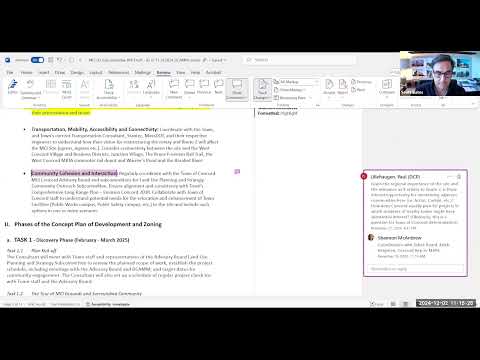
The Town of Concord advisory board reviewed and accepted a series of edits to the draft developer request for proposals prepared by DCAM, directing staff to incorporate historic-preservation references, MEPA-transferable language and several new deliverables for bidders.
The board's action centered on ensuring the consultant's work could support both planning and state environmental review. Speaker 1 said the MEPA reference should remain so that "the information that's being collected by the consultant [is] transferable to the MEPA process," and the group agreed to retain that language.
Why it matters: the RFP will shape the redevelopment of the MCI Concord site and set expectations for what bidders must study and deliver. Board members pushed to make preservation documentation explicit, to provide clear public-facing materials, and to define deliverables that bidders must submit.
Key details: Board members instructed staff to reference an earlier National Register eligibility study prepared with Anne McCarthy Forbes and the Town of Concord Historical Commission (discussed as the Town of Concord National Register nomination) so the consultant can build on existing research. The board added an "existing conditions" deliverable to the discovery phase and agreed on a separate written proposal for an inclusive community-engagement process and materials suitable for community presentations.
The advisory board also mandated public-facing materials as clear deliverables: a citizen's guide to form-based code and a short explainer on zoning changes. Speaker 1 proposed adding a "form-based code guidebook" and to include a one-page "understanding zoning" handout among deliverables. Speaker 6 offered a previously prepared MBTA-community FAQ as an example the consultant could use; the board agreed to include it as an attachment or example for bidders.
On zoning deliverables, the board emphasized that final outputs must include both textual amendments and mapping: "final text amendments, final zoning amendments" should be separate, actionable deliverables, the group said.
Schedule and next steps: members discussed timing with procurement staff; Speaker 3 said the goal was to issue the RFP as soon as possible (hoping for release on Friday), which would shift internal dates by roughly one week. The town-meeting target remains broadly described as spring 2026 because the town has not yet set an exact date. No formal vote was recorded; staff were directed to incorporate the agreed language and follow up with Paul and procurement on outstanding document availability.
The board also discussed, but did not adopt, additional public-engagement ideas such as an open design competition; members said a contest might be better suited to a later phase once the development framework is defined.
The advisory board will circulate revised RFP language to Shannon and reconvene review items with the advisory board and procurement staff before issuing the solicitation.