Get Full Government Meeting Transcripts, Videos, & Alerts Forever!
Get email alerts on the Electronic Voting topic
No spam. Unsubscribe anytime.
Concord committee recommends trial use of electronic voting clickers after close vote
Summary
The Concord Town Meeting Study Committee voted 6–1 to recommend that the town adopt electronic voting “clickers,” citing privacy and accuracy benefits while recording concerns about cost, logistics and potential effects on deliberation. The committee deferred a separate vote on a privacy policy to a future meeting.
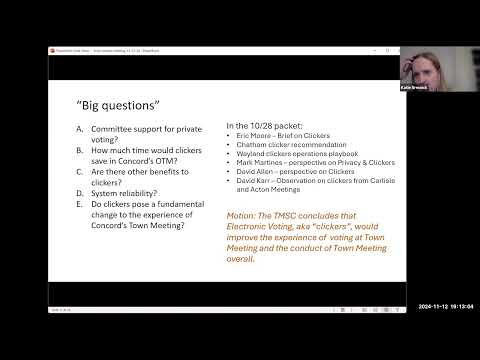
The Concord Town Meeting Study Committee voted on Nov. 20, 2024, to recommend the use of electronic voting devices, commonly called “clickers,” at town meeting. Committee Chair Eric Moore said the motion — “The TMSE concludes that the use of clickers may improve the experience of town meeting and therefore recommends use of clickers” — passed by roll call with six members voting in favor and one opposed.
The vote followed a lengthy discussion about tradeoffs. Public commenter David Carr told the committee he had timed votes from past meetings and warned that clickers can add time per vote and suffer device failures in large gatherings, noting differences in attendance between Concord (he cited about 1,131 attendees for a high-interest meeting) and smaller towns that report faster results with clickers. Several committee members agreed that clickers are unlikely to shorten ordinary visual votes but can save substantial time and provide accurate counts when hand-counted or secret ballots are required.
Members discussed cost estimates and procurement options. The committee heard benchmark examples: Wayland budgets roughly $50,000 a year for clickers, a Meridian purchase of about 1,500 units was estimated in the packet at roughly $50,000, and rental estimates were quoted as low as about $10 per meeting from some vendors and far higher from others. Phil Swain suggested exploring whether school-owned devices could be repurposed to reduce initial costs.
Privacy and community norms were central to the debate. Some speakers, including Cameron McKenna and public commenters, noted a committee survey of more than 1,000 residents showed roughly 86% support for clickers; committee members cautioned the survey did not specifically ask whether respondents sought clickers for privacy. Public commenters warned that private voting changes the traditional town‑meeting norm of voting publicly in front of neighbors and could affect deliberation dynamics.
Moderator Carmen Rees and others said administrative details — whether to rent or buy, how many devices, and how to check people in efficiently — are operational questions best handled by town staff if the committee recommends adoption. The committee agreed that a trial or rental period would be a reasonable way to test the technology before a purchase, although some members preferred a high-level recommendation without operational qualifiers.
On procedural next steps, the committee agreed to return to privacy policy in a subsequent meeting and to present the committee’s recommendations to the Select Board on Dec. 2. The motion carried with the following roll-call: Keith Bergman (Aye), Alice Kaufman (Yes), Katie Bresnick (Aye), Chase Thompson (Aye), Phil Swain (Yes), Kristen Haggerty (No), Eric Moore (Aye); Eric Van Loon and Parasharp Patel were absent.