Get Full Government Meeting Transcripts, Videos, & Alerts Forever!
Get email alerts on the Rfp Mci Concord topic
No spam. Unsubscribe anytime.
Concord advisory subcommittee narrows RFP scope, flags FY25 funding deadline and sets $600,000 placeholder
Summary
A Town of Concord advisory subcommittee reviewed red-line edits to an RFP for the MCI Concord property, agreed to remove community engagement from the RFP title while keeping it in scope, clarified FY25 funding is contingent on a state contract letter, agreed to request task-level cost breakdowns, and set a placeholder budget of $600,000.
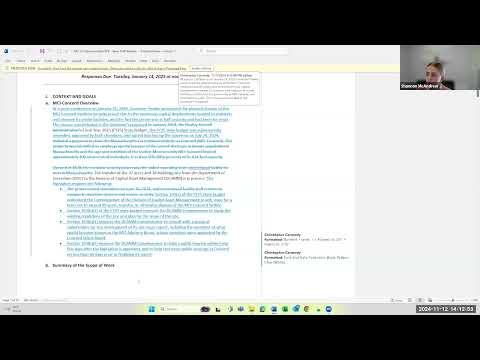
A Town of Concord advisory subcommittee met to review a red-line draft of the request for proposals (RFP) for the MCI Concord property and agreed on several edits to scope, deliverables and procurement requirements.
Committee members debated whether to use the term 'visioning' or 'concept planning' in the RFP title and whether to list 'community engagement and facilitation' at the front of the document. Several participants said community engagement is inherent to planning work and would be folded into the consultant team rather than hired separately; the group agreed to remove community engagement from the RFP title and keep it as a task within the contract. Speaker 2 said consultants are primarily being hired for planning, economic analysis and zoning work and that placing engagement first could depress interest; Speaker 3 confirmed engagement will be included within the consultant scope.
The committee noted funding timing tied to FY25 state allocations. Speaker 6 summarized the language the group discussed: “Funds for the FY25 project elements are allocated in the executed state budget and contingent upon execution of a funding contract.” Members agreed the town could select a vendor but that an executed contract may need to wait until the town receives the state funding letter; the committee agreed to add a sentence committing to seek additional funding for FY26 if needed.
Committee members also discussed deliverables and presentation materials. Megan urged adding summary measures that show positive impacts (for example, probable tax revenue) alongside potential costs, while other members warned that adding those measures could prompt requests for precise counts (jobs, housing units) that the RFP's scope may not be designed to produce. The group agreed to ask proposers to deliver land-use scenario summaries that include programmatic elements, probable tax revenue and municipal impacts within the agreed tasks.
To help the town compare proposals, the committee decided to require price proposals broken down by task and to request the hours or percentage of time each key staff member would dedicate to each task; Speaker 2 volunteered to prepare a spreadsheet template for vendors to use. The committee also discussed appendices for subconsultant rates and reimbursable costs and agreed those details could be requested in the proposal or clarified in interviews.
The committee flagged environmental permitting as a priority for data compatibility. Speaker 1 recommended that consultant-collected data be prepared so it is transferable into a NEPA (and MEPA) permitting process—what members described as an 'umbrella permit'—to reduce future duplication in permitting and to save the town money.
On schedule and budget, members stressed the FY25 funding deadline and the need for an aggressive timeline to meet a June 30, 2025 funding window. The committee placed a placeholder budget of $600,000 in the RFP 'for now' to give proposers a pricing reference; Speaker 2 said the number was a hold and could be adjusted. Members also discussed whether some tasks (for example, zoning work) might realistically start later if funds roll into FY26.
Speaker 3 said she will clean up the red-line document to reflect the committee's decisions and circulate a revised version for the advisory board packet. Before adjourning the subcommittee approved minutes for October 1, October 15 and October 29 by voice vote.
The committee's next step is for staff to circulate a cleaned-up red-line RFP incorporating the agreed edits, distribute a vendor price-comparison spreadsheet, and include the packet for review at the full advisory board meeting.