Get Full Government Meeting Transcripts, Videos, & Alerts Forever!
Get email alerts on the Land Use Solar Definitions topic
No spam. Unsubscribe anytime.
Chino Valley planning commission forwards revised definitions for solar and land-use terms to town council
Summary
The Planning and Zoning Commission unanimously approved text amendment TA 2024-05 on Oct. 1, 2024, clarifying definitions (many related to solar development) and will forward the amendment to Town Council; staff will return in November with a full solar ordinance addressing technical and environmental details.
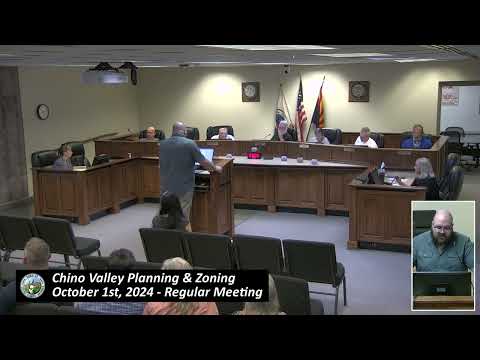
The Chino Valley Planning and Zoning Commission voted unanimously Oct. 1 to forward a text amendment that adds and revises definitions in the Town of Chino Valley Unified Development Ordinance, clearing preparatory language ahead of a full solar ordinance staff plans to bring in November.
Assistant Director for Development Services Will Dingy told commissioners the changes aim to fix gaps in the town code while a comprehensive zoning rewrite proceeds, which staff estimates could take about 18 months. Dingy read proposed language that includes definitions for battery energy storage systems (BESS), decommissioning plans, solar facility and array, private versus public utilities, ‘‘knuckle’’ and cul-de-sac frontage calculations, tracts and lots, utility generation facilities, and wildlife linkages identified by the Arizona Game and Fish Department. He said a ‘‘solar facility use permit’’ would be required before a project is deemed approved by the town.
During discussion commissioners pressed staff on specific wording. A decommissioning-plan paragraph originally required removal of ‘‘concrete and rebar up to 4 feet below the disturbed surface.’’ Commissioners asked why a depth limit was included; after debate staff agreed revised wording would require removal of all concrete and rebar above and below ground rather than limiting remediation to a fixed depth. Dingy also confirmed that the forthcoming ‘‘utility-scale’’ definition will be provided at the next meeting and that solar-facility language will encompass related components such as substations, transformers, transmission lines and battery storage.
The public comment period drew a lengthy statement from King Chan of unincorporated Yavapai County, who urged commissioners to scrutinize large-scale solar projects and raised concerns about broken panels, chemical leaching, and potential impacts to groundwater near an aquifer. Chan said he has observed industry emphasis on ‘‘reliability’’ and ‘‘economics’’ and asked the commission to ensure protections for water, wildlife and public safety. Dingy responded that the decommissioning standard and contamination remediation would be addressed in the full draft ordinance and through development agreements, which can require remediation plans for severe incidents such as storm-related panel breakage.
A commissioner emphasized that TA 2024-05 is limited to definitions and does not authorize any solar facility; Dingy and other staff reiterated that specific standards, siting requirements, acreage thresholds for utility-scale projects and mitigation measures will be set in the subsequent solar ordinance and development agreements.
A motion to approve TA 2024-05 ‘‘as presented, subject to the staff report and information provided during this hearing, including the changes that were made’’ passed on a roll-call vote with Commissioners Welker, Meaders, Switzer, Zamudio, Vice Chair Paciak and Chair Merritt voting yes. The commission closed the hearing and will forward its recommendation to the Chino Valley Town Council for final action. Staff also noted the town’s recent planning award and reported that two items previously forwarded to council — a ConEx text amendment and a rezoning for Christopher Barrett — were approved by council.
The commission’s next regular meeting is expected to include the draft solar ordinance (with the utility-scale acreage threshold and permit mechanics) and further discussion of wildlife linkages and decommissioning details.