Get Full Government Meeting Transcripts, Videos, & Alerts Forever!
Get email alerts on the Mattakees Site topic
No spam. Unsubscribe anytime.
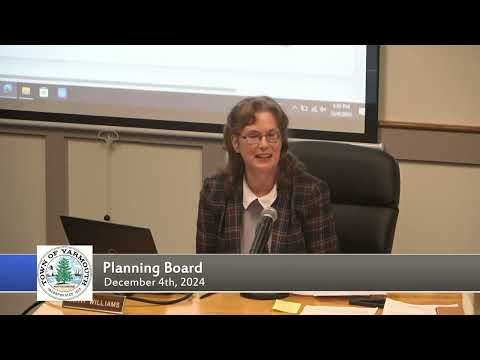
Yarmouth Planning Board discusses MUC process for former Mattakee's site
Summary
Planning Board members reviewed the Mattakee's Utilization Committee’s (MUC) proposed land‑use teams and schedule for evaluating the former Mattakee's school site at 400 Higgins Scribe Road, emphasized the need for Axios’ technical building review and more robust public outreach, and flagged sewer and environmental constraints.
The Yarmouth Planning Board on Dec. 4 reviewed the Mattakee's Utilization Committee’s plan to recruit land‑use teams to propose uses for the former Mattakee's school property at 400 Higgins Scribe Road.
Chair Joanna Crowley said the board received a Nov. 26 memo from the MUC chair and that staff materials included a zoning summary and brief site analysis. Kathy, a town staff member, described the MUC as "serving basically as liaisons to a bunch of different land use teams," and outlined six topic teams — housing, economic development and tourism, recreation, education, open space and municipal services — each expected to produce up to three proposals through a January–March schedule of brainstorming, reconciliation and proposal drafting.
Kathy told the board Axios has been retained as a technical consultant to assess the main building and prepare a video to convey building conditions to the public, noting that staff are "hesitant to allow people in the building because of its condition." Several members said Axios’ findings are essential before teams finalize proposals; Jim Sabin, a planning board member and longtime real-estate appraiser, urged that financial feasibility checks — "is it financially feasible? Is it physically possible?" — be applied before advancing ideas.
Board members flagged regulatory and infrastructure limits that will shape feasible uses. Kathy reviewed mapping showing wetland buffers, wellhead protection (zone 2) and critical-habitat areas, and warned the parcel’s 70 acres include large constrained areas. She said the parcel’s residential R40 zoning limits many commercial and retail uses and that approaches such as a town-controlled RFP or state tools (Chapter 40B or a Chapter 40R overlay) would require additional steps. Kathy also noted potential state and regional triggers including the Massachusetts Environmental Policy Act and Cape Cod Commission DRI processes.
Members discussed funding and consultant roles. Kathy said existing committee funds and a dedicated allocation will help: "We have $225,000 that was voted at town meeting for this analysis," and the town plans to engage a master development-plan consultant to coordinate technical work and ensure apples‑to‑apples comparisons among team proposals. Board members recommended guidance for any teams using public money for consultants so proposals answer the same core questions.
Members volunteered to serve as liaisons to the MUC teams and agreed to add a standing agenda item, starting in January, for members to report back on team meetings. Crowley said the select board will receive quarterly updates on the MUC process. The memo and mapping materials reviewed by the board are posted with the committee packet on the town’s website; Kathy said more detailed scaled mapping will follow as consultants finalize plans.
The board did not take a formal vote on land‑use recommendations at the meeting; Kathy and chair Crowley said teams would present proposals later in the process for MUC distillation and eventual Select Board consideration.