Get Full Government Meeting Transcripts, Videos, & Alerts Forever!
Get email alerts on the Coastal Management topic
No spam. Unsubscribe anytime.
Yarmouth orders Crow Beach Association to modify unpermitted stockade fence in velocity flood zone
Summary
After staff found the Crow Beach Association rebuilt a stockade fence in a coastal velocity flood zone without a permit, the conservation commission voted to issue an enforcement order requiring a 6-inch bottom clearance and removal of slats (consistent spacing) to allow floodwaters to pass.
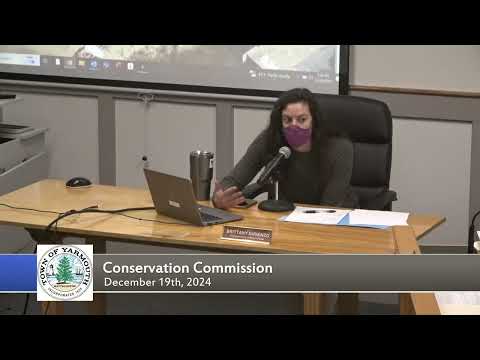
The Yarmouth Conservation Commission voted Dec. 19 to issue an enforcement order requiring the Crow Beach Association to modify a recently reconstructed stockade fence that staff said was built without a building permit in a coastal velocity flood zone.
Brittney, conservation staff, told the commission the fence had been reconstructed and that current regulations do not allow solid stockade fences in the velocity zone. She recommended an enforcement order requiring a minimum 6 inches of clearance at the bottom of the fence and the selective removal of slats to provide consistent gaps that allow floodwater to pass.
Carl Valeri, identified in the record as president of the Coral Beach Association, and David Meadows, a nearby property owner who said his association had maintained the parking lot for decades, described the fence history and said volunteers replaced several panels without realizing a permit was required. "We did not believe we needed a permit to... replace the fence panels," Valeri said, adding that the work was done by community volunteers and took only a couple of hours.
Commissioners stressed that permitting and flood-flow functionality are the core issues. Staff said that if the fence remains fully solid it can redirect and channelize water, increasing velocity and risk to neighboring properties; staff recommended the aesthetic concerns be secondary to allowing flow. The commission discussed options — such as cutting 6 inches from the bottom and removing slats in a consistent pattern or converting to post-and-rail — and agreed to leave the enforcement order somewhat flexible about the spacing so long as the objective of unimpeded flow is achieved.
A motion to issue the enforcement order with the discussed conditions was moved and seconded and carried. Staff will supply the association with the enforcement order and a list of acceptable plantings and structural modifications; the commission suggested the association may need to file an after-the-fact building permit if the fence exceeds the town's thresholds for building permits.