Get Full Government Meeting Transcripts, Videos, & Alerts Forever!
Get email alerts on the School Facilities topic
No spam. Unsubscribe anytime.
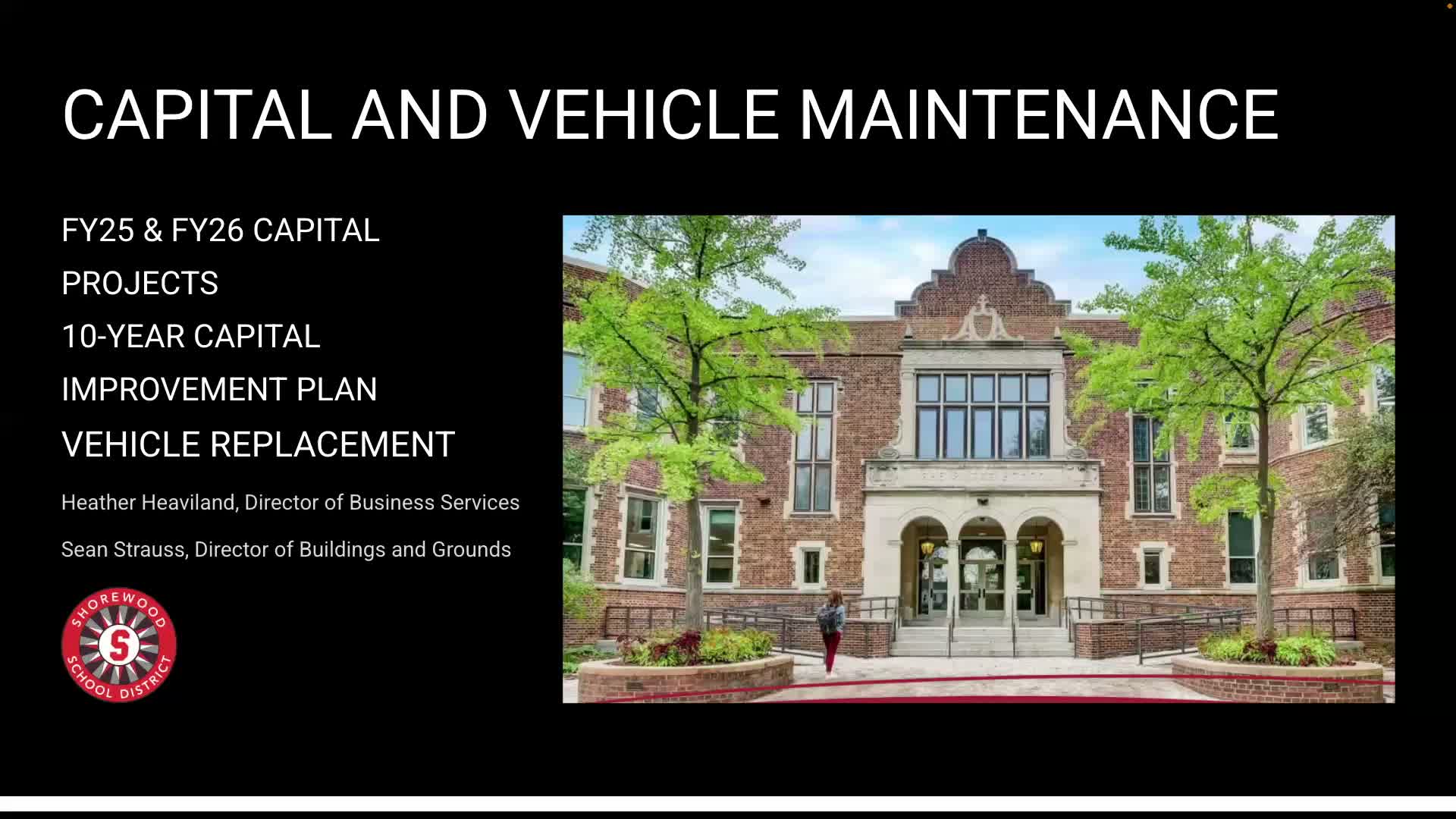
School board approves 10-year capital maintenance plan; roofs, HVAC and SIS elevator highlighted
Summary
The board approved a 10-year capital maintenance plan covering essential infrastructure and quality maintenance. District leaders flagged roofs, a major SIS air-handler replacement, elevator phase two, and a planned vehicle-replacement set-aside as priorities.
District administrators presented a long‑range capital maintenance plan and a set of FY25–26 priorities, and the board voted to approve the plan.
Administrators told the board that essential infrastructure needs over the next five years total roughly $5.7 million, rising to about $9.0 million over a ten‑year horizon; about $1.2 million of priorities for FY25–26 were highlighted, with approximately $500,000 slated for roof work and a major SIS (school) air‑handler replacement among the top items.
The presentation listed completed projects (districtwide access control programming, stadium asphalt work, SIS elevator phase 1, tuck‑pointing, fiber upgrades, parking-lot re-striping) and in‑progress items. Administrators warned that supply‑chain pressures and vendor price volatility (including potential tariff effects and limited manufacturer support for legacy systems) have increased uncertainty and that the district is trying to lock prices on some contracts where possible.
On vehicles, the board reviewed fleet replacement history and a proposed annual set‑aside of $141,000 to stabilize future purchases. The district plans a phased replacement strategy to keep a portion of vehicles in service 15–20 years and to stagger purchases to avoid large one‑time spikes. The administration noted one planned purchase using food‑service funds: a dedicated food‑delivery truck to replace a van used for meal distribution.
Board members asked about the roofing‑replacement schedule, the projected $1–1.6 million annual average for capital needs, and whether the district aims to avoid another facilities referendum; administrators said the plan intends to smooth costs using reserve funds so any future referendum would be elective rather than for urgent, unmet needs.
What happens next: the long‑term plan will be incorporated into the preliminary budget presented in June; administration will return with indicators, contract recommendations and any recommended budget‑balancing strategies.