Get Full Government Meeting Transcripts, Videos, & Alerts Forever!
Get email alerts on the Committee Roundup topic
No spam. Unsubscribe anytime.
Senate transportation committee advances several bills, deadlocks on highway procurement expansion
Summary
The Senate Transportation, Technology & Legislative Affairs committee passed multiple bills including a cybersecurity public‑private partnership and a trucking safety clarification, but a roll call produced a 3–3 tie on a plan to expand a highway procurement pilot and that motion failed. Committee members requested more RFP language clarity and comparative studies before reconsidering the pilot.
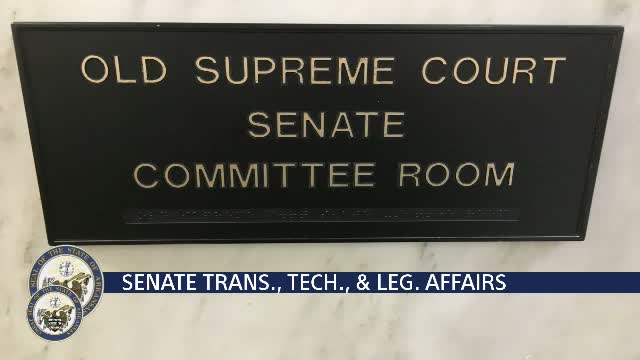
The Senate Transportation, Technology & Legislative Affairs committee met and moved a package of bills while holding extended debate over a highway procurement pilot that would change how the Arkansas Department of Transportation (ARDOT) hires builders for certain projects.
Chair (unnamed) opened the meeting and the panel approved a short docket of bills by voice: an opening item identified in the transcript as “Senate bill 5 89” passed after a motion and second; House Bill 1448, a trucking industry bill clarifying that in‑cab safety coaching and technologies can be applied to both employees and contract drivers without altering employment status, passed after testimony from Katie Shannon of the Arkansas Trucking Association; and House Bill 1826 — which would let the governor, rather than the director of the Department of Information Systems, designate the State Broadband Manager — also passed on a voice vote.
The committee gave more time to debate two larger items. A bill to establish a public‑private cyber alliance with the Department of Economic Development (sponsored with testimony from Major Scott Anderson of the Arkansas Air National Guard and Lee Watson, CEO of the American Cyber Alliance) was advanced as amended. Watson said the alliance is intended to close gaps in workforce development, innovation and information sharing, noting that “90% of critical infrastructure across the country and in Arkansas is owned and operated by the private sector.” Committee members asked whether vulnerability data would be publicly available; presenters said such information would be secured and shared only inside controlled channels (they referenced participation with MS‑ISAC).
The session’s longest debate centered on House Bill 1693, a follow‑up to a 2017 pilot established by Act 6809 that originally authorized three construction projects under a $200,000,000 cap and required sequential completion. The amendment before the committee would allow up to five projects under the same $200 million cap and remove the sequential‑only requirement so more than one project could proceed at the same time. ARDOT representatives described the Construction Manager/General Contractor (CMGC) model used on the I‑430 project and said the method produced an estimated $7,000,000 savings on a roughly $70,000,000 job; ARDOT staff also said they expect 15–20% savings in some CMGC procurements and that 14–18 states have used similar approaches.
Senators pressed ARDOT on RFP language, whether the amendment removed protections that would allow local contractors to compete, and whether a large general contractor might use preferred, potentially out‑of‑state subcontractors. One senator asked why language that would have explicitly allowed not requiring prior experience had been struck from the amendment; ARDOT staff said the amendment author rewrote the RFP language to make it more flexible. After debate and an apparent voice vote, a requested roll call produced a 3–3 tally and the chair announced the motion to pass House Bill 1693 as amended had failed. Committee members asked ARDOT for comparative studies from other states, clearer RFP provisions and audit‑ready metrics before returning the measure to committee.
Near the end of the meeting the panel advanced a bill related to ATV liability (House Bill 1833) after brief presentation by Blake Johnson and carried other bills as noted on the docket; several bills were deferred for future committee consideration. With no further business the chair adjourned the meeting.
Votes at a glance • “Senate bill 5 89”: voice vote — passed. • Senate Bill 6 32 (cyber alliance): passed as amended (voice vote). • House Bill 1448 (trucking safety/coaching): passed (voice vote). • House Bill 1826 (State Broadband Manager appointment): passed (voice vote). • House Bill 1693 (ARDOT procurement pilot expansion): motion to pass as amended failed on roll call (3–3 tie); committee requested additional materials and may revisit. • House Bill 1833 (ATV liability waiver): passed (voice vote).
What’s next: ARDOT staff told senators they will try to supply comparative studies and more detailed RFP language; the committee left open the possibility of returning the procurement pilot for reconsideration once additional information is provided.