Get Full Government Meeting Transcripts, Videos, & Alerts Forever!
Get email alerts on the Employer Vaccine Mandates topic
No spam. Unsubscribe anytime.
Arkansas legislators hear hours of testimony on employer vaccine mandates; interim study on vaccination privacy adopted
Summary
A joint Senate Judiciary and House/Senate Insurance & Commerce Committee hearing drew business leaders, legal advisers, public-health officials and dozens of public commenters to debate employer COVID-19 vaccine requirements. Lawmakers adopted an interim study proposal on vaccination privacy and protections for employees who decline to disclose status.
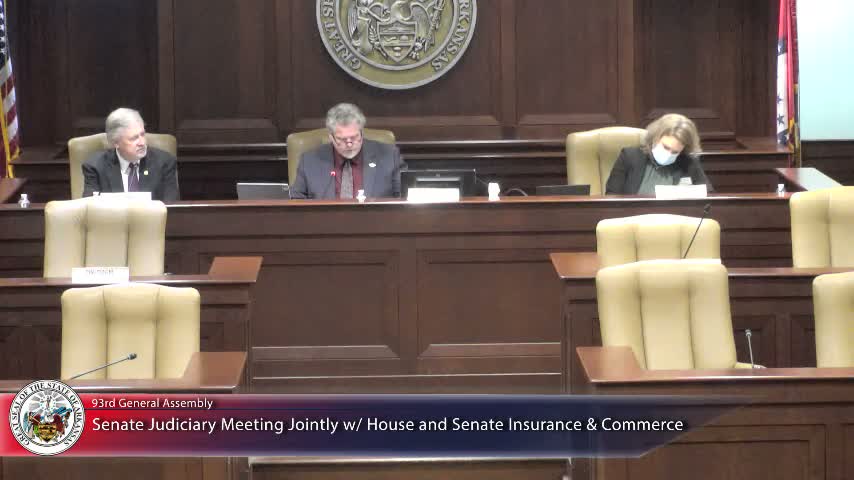
LITTLE ROCK — The Senate Judiciary Committee, meeting jointly with House and Senate insurance and commerce members, spent more than five hours Tuesday hearing testimony on employer COVID-19 vaccine mandates and related legal, medical and workforce concerns. Business representatives, legal counsel, public-health officials and dozens of employees and citizens testified before the committee adopted an interim study proposal to examine vaccination privacy and protections for employees.
The hearing opened with business testimony. Randy Zook, president and CEO of the Arkansas State Chamber of Commerce, told legislators the state faces an historic worker shortage and warned that bills barring employers from requiring or even asking about vaccine status would carry legal and operational risks. "This would subject those businesses to substantial fines and other penalties," Zook said, and he argued that prohibiting employers from ascertaining vaccination status could prevent compliance with Centers for Disease Control and Arkansas Department of Health guidance and strip businesses of defenses against negligence claims.
Tom Brower, senior vice president for occupational safety and health at Tyson Foods, described the company—fforts during the pandemic, saying the company had spent "hundreds of millions of dollars" to protect employees and had carried out on-site vaccination clinics and testing programs. Brower confirmed that Tyson planned to require vaccination for remaining U.S. employees by Nov. 1 and said the company would evaluate medical and religious accommodation requests through its normal HR process. "At Tyson Foods, the health and safety of our team members is our top priority," he said.
Committee members pressed witnesses on several fronts: whether the discussion concerned only private employers, how Title VII and the Americans with Disabilities Act apply to religious and medical accommodations, and whether vaccines meaningfully reduce transmission amid Delta-variant breakthroughs. Brower and Zook repeatedly pointed to CDC and FDA guidance as the basis for company decisions and said exemptions are evaluated individually.
Legal advisers from the attorney general's office and a law professor later briefed the committee on where the law currently stands. Staff from the attorney general—xplained the distinction between state actors (where constitutional limits apply) and private employers (where contract and statutory law generally govern) and said private employers in Arkansas generally retain the right to set conditions of employment subject to statutory exceptions. UALR law professor Robert Steinbach said precedent such as Jacobson v. Massachusetts provides some authority for public-health measures, but he warned that judicial outcomes can turn on politics and that recent state litigation had produced conflicting rulings about mask and vaccine statutes.
Public-health officials answered lawmakers' questions about safety monitoring and adverse-event reporting. Dr. Jennifer Dillehay, medical director for immunizations at the Arkansas Department of Health, summarized the federal monitoring systems — VAERS, the Vaccine Safety Datalink and clinical assessment collaborations — and listed adverse events that have been investigated (anaphylaxis, thrombosis with thrombocytopenia associated with Janssen, cases of Guillain-Barre9 and confirmed myocarditis/pericarditis in young males). She also noted that manufacturers had submitted data to the Food and Drug Administration for potential full licensure of mRNA vaccines.
The hearing included an extended public-comment period. Dozens of employees, many of them health-care workers, described being caught between employer deadlines and personal, medical or religious concerns. Some speakers said they had requested or expected to request accommodations but worried about opaque or burdensome review processes. A number of witnesses described adverse events they or family members experienced after vaccination and said they found the reporting process confusing or unresponsive.
Several legislators raised the practical consequences employers may face if many workers refuse a mandate. "Can we lose 18% of our workforce? We can't lose 2% of our workforce," asked one lawmaker, reflecting witnesses' concerns about hiring shortages in critical industries such as meatpacking and health care.
As a procedural outcome of the hearing, Senator Ballinger moved and the committee approved an interim study proposal (ISP) to consider establishing a statutory right to keep vaccination status private and to prohibit retaliation against employees who refuse to provide that information. The measure was adopted by voice vote; the chair clarified that the ISP creates a study for the interim and does not itself change the law.
The committee did not vote on any bill during the session. Chair remarks at adjournment thanked business witnesses, the attorney general's office, public-health officials and members of the public for their testimony and emphasized the committee will review the ISP findings during the interim.
What happens next: The interim study will gather additional evidence and stakeholder input for the committee to consider before proposing legislation. Lawmakers said they would continue to consult legal, medical and business stakeholders as they weigh statutory limits on employer policies, accommodations processes and the balance between workplace safety and employee medical privacy.
(Reporting note: Committee testimony and direct quotes are taken from the official hearing transcript.)