Get Full Government Meeting Transcripts, Videos, & Alerts Forever!
Get email alerts on the Traffic Safety topic
No spam. Unsubscribe anytime.
Senate committee advances bill to make most adult texting a secondary offense after testimony about stoplight tickets
Summary
SB 66 would stop officers from writing texting-related tickets when drivers are stopped (for example, at stoplights) and reclassify texting while driving for adults over 21 from a primary to a secondary offense; the Senate committee passed the bill despite opposition from state police and safety advocates who warned of enforcement and funding losses.
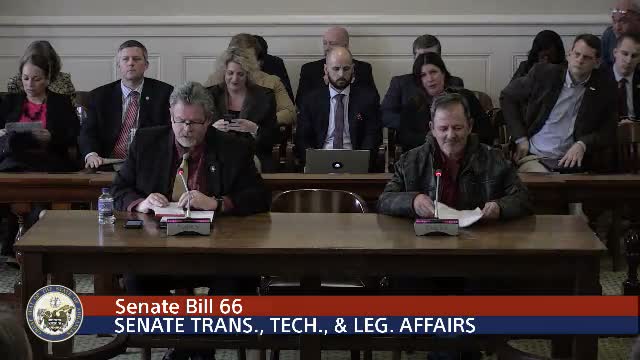
Senator Clark urged the Senate Transportation, Technology & Legislative Affairs Committee on SB 66, saying the bill would prevent tickets for phone use while a vehicle is stopped and change texting while driving for people over 21 from a primary to a secondary offense. Clark framed the measure as protecting law-abiding adults who use phones for work and as a response to what he called intrusive enforcement at stoplights.
Tim Rasch, a Hot Springs general contractor, described receiving two tickets while stopped at red lights and said he was not texting. Rasch told the committee he “shouldn't be fined for that,” and asked for a distinction between glancing at a phone while stopped and other brief glances at a vehicle's dash.
Major Forrest Marks of the Arkansas State Police testified the state police oppose the bill, saying the change would set enforcement back and limit officers’ ability to act unless another enforceable offense is present. Marks and other witnesses explained electronic tickets use a general phrase such as “use of an electronic communication device,” and that the statute number and crash reports supply the legal elements for court review.
State police and safety advocates also warned the change could affect federal safety grant eligibility. Committee witnesses said that, under relevant federal guidance, moving texting from primary to secondary could risk roughly $300,000 in federal highway or safety grant funding that supports training and prevention programs across the state.
Supporters, including the sponsor, said the intent is not to condone texting while driving but to reduce what they described as overbroad stops of stationary drivers and to avoid penalizing drivers who use a phone briefly while stopped. Opponents said public-safety gains from the existing primary-texting law and the ability to seek federal funds outweigh that concern.
The committee adopted a motion to advance the bill, with Senator Hammer moving “do pass,” Senator Davis seconding, and the chair announcing the motion passed. SB 66 will move forward from committee to the next stage of consideration.
The committee hearing included multiple rounds of questions from senators about how electronic tickets are coded, whether officers receive specific training for distracted-driving enforcement, and whether the available crash data can isolate phone-related fatalities. Witnesses said extracting texting-specific crash causation requires case-by-case review of crash reports.