Get Full Government Meeting Transcripts, Videos, & Alerts Forever!
Get email alerts on the Fines And Fees topic
No spam. Unsubscribe anytime.
Judiciary committee backs eliminating $10 monthly installment fee, asks legislature to backfill revenue
Summary
The Senate Judiciary Committee voted to include a recommendation in its legislative study to eliminate the $10 monthly installment convenience fee defendants pay when they set up payment plans, while asking that the legislature identify replacement revenue so court technology and related programs are not underfunded.
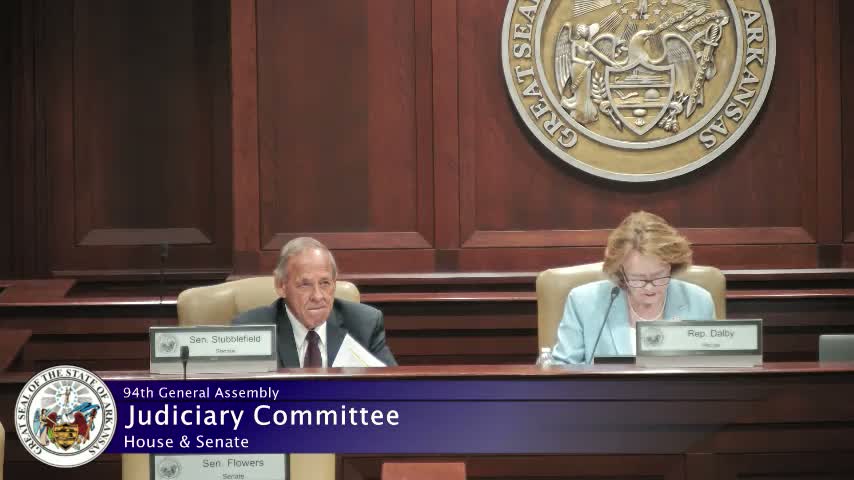
The Senate Judiciary Committee, meeting in a joint study session with the House Judiciary Committee, voted to include in its final report a recommendation to eliminate the $10 monthly installment convenience fee that defendants pay when they set up payments for fines and court costs. Chair Dolby said the fee is ‘‘often harmful’’ to people who pay over long periods and directed the report to recommend eliminating the fee while requiring the legislature to identify a backfill for the revenue the fee now generates.
County officials told the committee the $10 fee is split: district courts retain $2.50 and the Administrative Office of the Courts (AOC) receives $7.50. Mark Whitmore of the Association of Arkansas Counties said the $2.50 retained locally generates about $3.3 million statewide; the committee heard that AOC’s share supports court technology and other AOC systems. Whitmore said county judges and the Municipal League are open to eliminating the monthly charge ‘‘if the revenue is replaced’’ so courts are not harmed.
Members debated alternatives presented during the discussion. Some support surfaced for one‑time or distributed alternatives: AOC had proposed a one‑time $50 upfront convenience fee and members discussed a $5 per‑ticket subsidy as another option. Representative Collins and others said the monthly fee can be regressive and, over long payment periods, sometimes exceed the original fine; Collins said it creates an ‘‘uneven administration of justice’’ for people with fewer resources. Opponents of a simple elimination cautioned that removing the fee without a replacement would deprive district courts of roughly $3.3 million and would reduce other AOC funding streams.
The committee voted by voice to include the recommendation to eliminate the $10 monthly convenience fee in its report, with the specific backfill mechanism to be determined by subsequent legislative work. The motion passed by voice vote; the committee did not adopt a specific replacement at this meeting.
What happens next: staff and interested stakeholders were asked to develop language for the report and to identify revenue options for the legislature to consider before the committee reconvenes to finalize the report.