Get Full Government Meeting Transcripts, Videos, & Alerts Forever!
Get email alerts on the Court Funding topic
No spam. Unsubscribe anytime.
Audit finds complex AOJ funding flows; committee presses questions on fees, retained shares and data gaps
Summary
A Legislative Audit special report presented to the Senate Judiciary Committee detailed district- and state-level court revenues and AOJ (Administration of Justice) fund distributions, flagged data gaps from three local courts, and prompted lawmakers to press AOC and audit staff for ranked financial spreadsheets and further analysis of the $10 installment fee and its effect on low-income defendants.
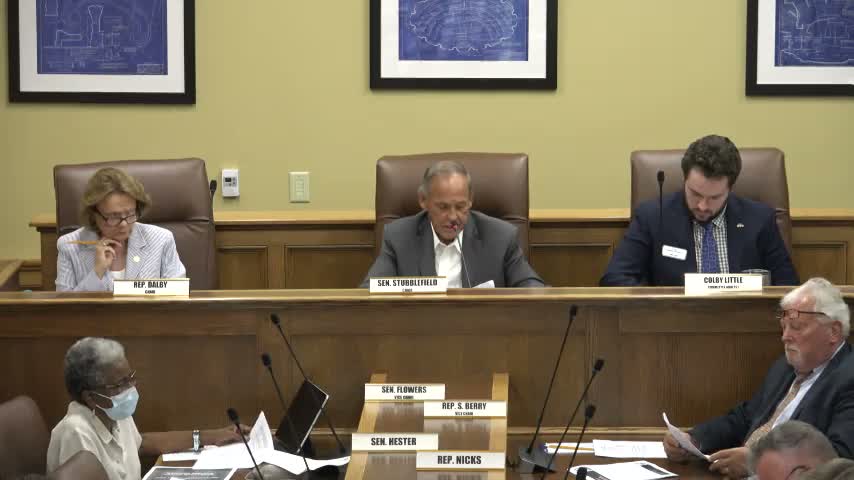
The Senate Judiciary Committee received a Legislative Audit special report that summarized district-court finances for calendar year 2023, documented the Administration of Justice (AOJ) fund flows, and prompted detailed questioning about fee structures, retained shares and missing local data.
Heather Lampkin of Arkansas Legislative Audit told the committee the state had 39 state district courts and 10 local district courts in 2023 and that audit staff compiled annualized district-court revenues of about $119.4 million for calendar year 2023, including roughly $59.3 million in state-generated revenues and $60.1 million from local entities. Lampkin said annualized expenditures totaled about $80.2 million and that a $23.4 million excess at the state level was primarily attributable to inclusion of State AOJ revenues totaling about $24.7 million.
Several committee members pressed audit staff on data gaps and on the retained-share calculations that determine how much local courts keep versus remit to the state. Audit staff said three local entities—Alpena, Rockport and Haskell—did not provide requested data. Committee members and audit staff noted retained shares were historically set in the mid-1990s based on collections at that time and have received occasional cost-of-living adjustments, producing inconsistent retained-share outcomes across jurisdictions.
The committee focused substantial attention on the $10 monthly installment fee assessed when defendants use time-payment plans. AOC witnesses Sam Kaufman and Tim Holtoff explained the installment fee is split: $5 is remitted to the state AOJ fund, $2.50 to the Judicial Fine Collection Enhancement Fund at the Administrative Office of the Courts (AOC), and $2.50 to the local district court automation fund. AOC staff told the committee that the $2.50 state share for court automation and related fees funds nearly half of the AOC court information systems (CIS) division budget and supports personnel and licensed systems used statewide. They warned that eliminating the fee without a replacement funding source would jeopardize court technology and services.
Lawmakers expressed equity concerns about installment fees being borne disproportionately by low-income defendants and asked audit and AOC to provide further data. Specific follow-ups requested by the committee included: a ranked spreadsheet of revenues and expenditures by court and district; the list of district judges who responded to the District Judges Council survey; additional detail on installment-fee collections and average monthly payments; and consideration of policy options such as replacing a recurring monthly fee with a one-time convenience charge or a direct general-revenue appropriation.
Audit and AOC staff agreed to provide the requested breakdowns and to work with legislative audit and BFA staff to assemble ranked tables; the committee scheduled follow-up work for September and indicated the study and recommendations are due Oct. 1.