Get Full Government Meeting Transcripts, Videos, & Alerts Forever!
Get email alerts on the Court Funding topic
No spam. Unsubscribe anytime.
Counties say they still cover $4 million shortfall for district judges as legislators await audit, cite wide local variance in retained fees
Summary
Association of Arkansas Counties and municipal representatives told the joint committee that retained shares set in 1994 produce wide disparities in revenue, local governments still cover about $4,000,000 in district-judge salary shortfalls, and the committee expects DF&A and legislative audit results before its August meeting.
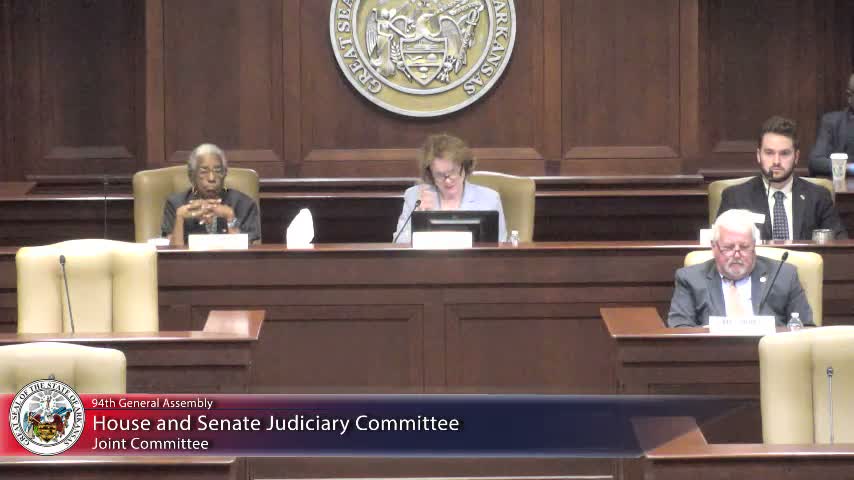
Taylor Anford, policy staff with the Association of Arkansas Counties, told the joint House and Senate Judiciary Committee that the Act 38 study is examining funding sources, collections and distribution systems for Arkansas district courts and that several recurring issues have emerged: counties and cities "are still paying around $4,000,000 for district court judges' salaries," retained shares vary widely by district because the retained share was set based on collections as of Dec. 31, 1994, and installment payment fees have raised equity concerns for defendants who must make long-term payments.
"We believe ... overall, the local governments will have spent ... and there will be a deficit for the revenue that is coming into district courts," Anford told the committee. He said installment payment fees help fund local automation and technology but that part of court costs flows upstream to the State Administration of Justice Fund, which prioritizes items such as trial-court coordinators and court reporters.
Rusty McMillan, Greene County judge and president of the County Judges Association, detailed a local interlocal arrangement in his Seventeenth Judicial District. He said the 2024 district‑clerk budget was about $334,000, with Greene County's side about $12,480, and that a $58,650 contribution represents roughly one-third of a state district judge's $168,000 salary. McMillan said combining clerk offices and personnel across counties "has worked out very well" operationally but noted funding burdens remain for counties and cities.
Blake Gary, legal counsel with the Arkansas Municipal League, cited Arkansas Code 16-10-307 (County Administration of Justice Fund) and 16-10-308 (City Administration of Justice Fund), explaining the statutes set a municipality's retained share based on what it retained as of Dec. 31, 1994, and that the formulas are complex. Gary said some municipalities retain as little as 5% while others retain much more.
Committee members sought a district-by-district breakdown. The chair told members that a DF&A audit and a legislative audit will be available before the committee's August meeting and should show how much each district collected, how much the state received and how much each district retained. The committee asked the County Judges Association and Municipal League to poll members and prepare top legislative recommendations in the coming month so the committee can consider proposals when audit findings are presented.
The committee also flagged the installment-payment fee as an equity concern for defendants. The chair said the committee will scrutinize that fee because it can leave defendants with long-term financial burdens. Committee deadlines: auditors' reports before August meeting; committee to consider recommendations and vote on final recommendations by Sept. 18 so draft legislation can be prepared and delivered to executive and judicial leaders by October.