Get Full Government Meeting Transcripts, Videos, & Alerts Forever!
Get email alerts on the Committee Votes Roundup topic
No spam. Unsubscribe anytime.
Votes at a glance: Judiciary Committee advances package of criminal-justice bills
Summary
The Senate Judiciary Committee passed a slate of criminal-justice and public-safety bills by voice vote, including measures on pharmacy burglaries, pardon denials with prejudice, fleeing law enforcement penalties, drug-task-force funding, child-safety offenses, human-trafficking solicitation, law-library governance, nuisance abatement, and domestic-violence enhancements.
The Senate Judiciary Committee advanced a group of bills by voice vote that addressed a range of criminal-justice and governance topics. Lawmakers approved the items below for further consideration in the legislative process.
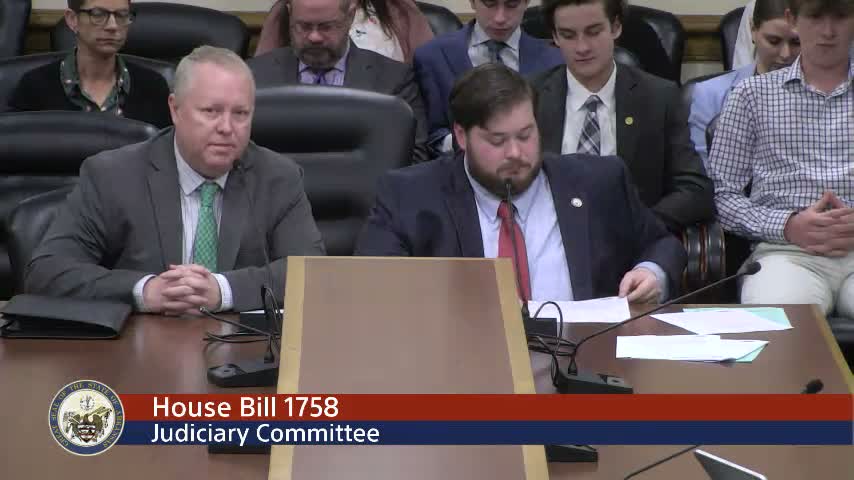
House Bill 17 58 (presented by John Vincent, CEO, Arkansas Pharmacists Association): Adds an enhanced penalty for commercial pharmacy burglaries to deter organized rings targeting pharmacies. Committee advanced the bill by voice vote.
House Bill 16 78 (sponsor: Senator Gilmore): Allows the sitting governor to deny pardon or commutation applications "with prejudice" for the length of the governor's term (4 or 8 years), with sponsors saying the change aims to reduce repeat filings and administrative backlog. Committee advanced the bill by voice vote.
House Bill 16 23 (sponsor: Senator Dave Wallace): Proposes raised penalties for fleeing law enforcement in circumstances of excessive speed or conduct that creates substantial danger to others; sponsors said offenses would be reclassified in severity depending on conduct and outcome. Committee advanced the bill by voice vote.
House Bill 16 03 (presented by Representative Mary Bentley): Raises the drug assessment fee from $125 to $150 for drug task forces and removes a $1,500 equipment-cap cap to help cover higher operational costs. Committee advanced the bill by voice vote.
House Bill 16 72 (sponsor: Senator Jim Petty): Adds the attorney general to the list of officials authorized to file civil nuisance-abatement suits against properties meeting statutory criteria; sponsors said the change is civil, not criminal. Committee advanced the bill by voice vote.
House Bill 16 47 (sponsor: Senator Jim Petty): Creates an offense termed "offensive relations with a child" to close a statutory gap identified by local law enforcement; the bill was presented as an emergency measure and advanced by voice vote.
Senate Bill 377 (concurrence, sponsor: Senator Tucker): Committee concurred with an amendment clarifying signature-collection criminal liability and clarifying the removal versus destruction of signatures.
House Bill 16 66 (sponsor: Senator Tucker): Tweak to judgment-collection law to ensure judgments against nonresidents can be enforced similarly to residents; part of a bar association package. Committee advanced the bill by voice vote.
House Bill 17 90 (presented by Lori Capurras, deputy prosecutor coordinator): Adds aggravated assault on a family or household member to the list of offenses that can trigger repeat-offender domestic-battery enhancements. Committee advanced the bill by voice vote.
House Bill 15 02 (presented by Representative Jimmy Gasaway): Creates a solicitation-of-a-minor offense in the human-trafficking code, criminalizes paying or offering a thing of value to engage a minor, sets class B felony penalties (5–20 years) and increased fines (between $5,000 and $15,000) with proceeds directed to victim-support funds. Committee advanced the bill by voice vote.
House Bill 16 64 (presented by Representative Jimmy Gasaway): Allows inclusion of a circuit judge and a district judge as eligible appointees to county law-library boards; committee discussed potential conflicts of interest and advanced the bill by voice vote.
All items were advanced by voice vote; the committee did not record roll-call tallies in this session. Next steps for each bill are additional committee hearings or floor action as scheduled.