Get Full Government Meeting Transcripts, Videos, & Alerts Forever!
Get email alerts on the Sb 484 topic
No spam. Unsubscribe anytime.
Senate Judiciary Committee rejects bill to remove Arkansas' duty to retreat after hours of testimony
Summary
After hours of committee questioning and more than a dozen public witnesses, the Senate Judiciary Committee failed to advance Senate Bill 484 — a sponsor‑backed change to Arkansas' self‑defense law that would prohibit triers of fact from considering whether a person failed to retreat.
Senate Bill 484 — the proposal from Sen. Ballinger to remove a statutory duty to retreat in Arkansas — drew multi‑hour debate, extensive public testimony and a firm split between the bill sponsor and law‑enforcement and prosecutorial witnesses. The committee voted on a motion to pass the bill as amended; the motion failed on a roll call vote, 3 yeas to 4 nays, and the bill did not move out of committee.
Ballinger, the bill’s sponsor, said the measure is largely a ‘‘clean‑up’’ to align Arkansas law with how prosecutors usually evaluate self‑defense claims. He told the committee the bill ‘‘makes it clear there’s no duty to retreat’’ and argued the change would put statute in step with practice in 31 other states and better protect victims who face imminent harm.
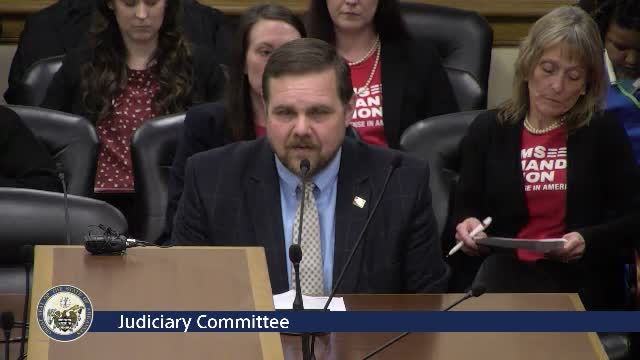
Opponents included elected prosecutors, state police and representatives of sheriffs and police chiefs. Bob McMahon, prosecutor coordinator for the Prosecuting Attorneys Association, told the committee that the state’s current code and a 2015 legislative clarification already cover situations where an individual cannot retreat with ‘‘complete safety’’ and that ‘‘current law is still adequate.’’ Prosecutors warned that SB 484 would remove material evidence about whether someone could have safely withdrawn from a confrontation, limit what a jury or judge could hear, and create opportunities for escalation and misuse of the self‑defense claim.
Witnesses from advocacy groups and survivors framed the bill as a public‑safety risk. Kate Fletcher of Moms Demand Action said she opposed the bill and cited peer‑reviewed research she said links similar laws to higher homicide rates and racially disparate outcomes: "Passing this law will quite simply ensure that more Arkansans needlessly die," she said. Several witnesses from the NAACP, the Arkansas Support Network and the Arkansas Poor People’s Campaign warned the bill would disproportionately endanger people of color and people with disabilities.
Supporters offered personal narratives and hypotheticals. Sen. Trent Garner recounted an armed‑robbery encounter from his life to illustrate the split‑second nature of many violent confrontations and said the change would matter most in the courtroom, not on the streets. Ballinger repeatedly told the committee that prosecutors and judges already apply a reasonableness standard and that the bill merely aligns the code with that practice.
Committee procedure consumed much of the hearing. Members debated limits on public testimony, first rejecting a motion to impose a 20‑minute per‑side cap and later approving a 10‑minute per‑side limit. Several members urged allowing a single spokesman for organized groups to avoid repetitive testimony while preserving broad public input.
At the final vote to pass SB 484 as amended, the roll call recorded these positions: Sen. Stubblefield — yes; Sen. Cooper — no; Sen. Rice — yes; Sen. Bond — no; Sen. Ballinger — yes; Sen. Leding — no; Sen. Flowers/Chair — no; the bill failed 3–4.
What’s next: Because the committee did not report SB 484 favorably, it will not advance from the Judiciary Committee in this form unless refiled or reconsidered by the sponsor. The transcript records detailed concerns from investigators and prosecutors about excluding evidence of retreat and sustained testimony from public‑safety organizations urging caution before changing the self‑defense standard.